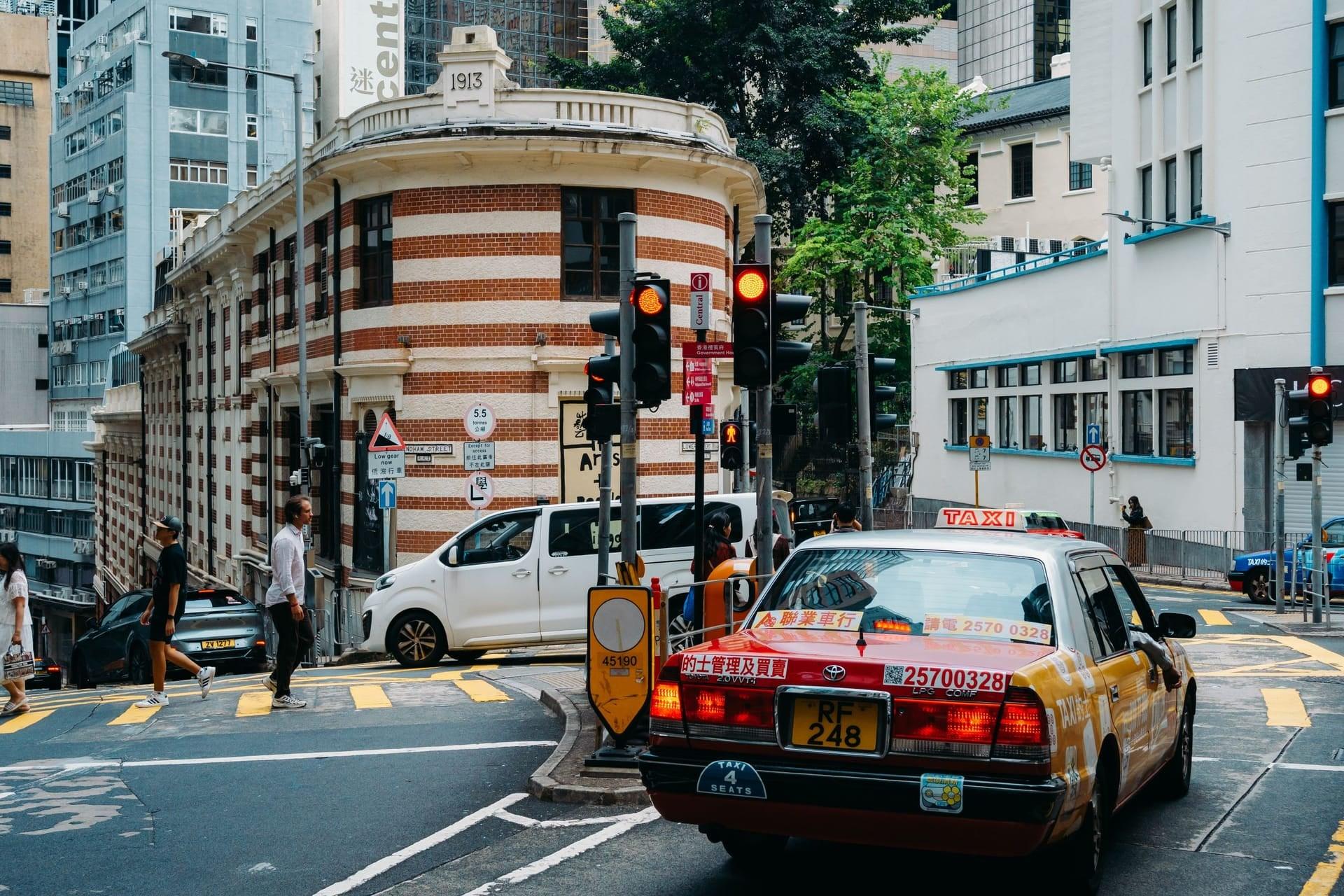
Hong Kong's first city from the reclaimed harbor up to the hill: Statue Square and the Cenotaph, the Old Supreme Court, HSBC's 1986 tower, St John's Cathedral, the Duddell Street gas lamps, Pottinger Street's slabs, the Central Market, Graham Street's market, the Mid-Levels escalator and Tai Kwun.
Start · Statue Square (皇后像廣場)
DirectionsStops
- 1
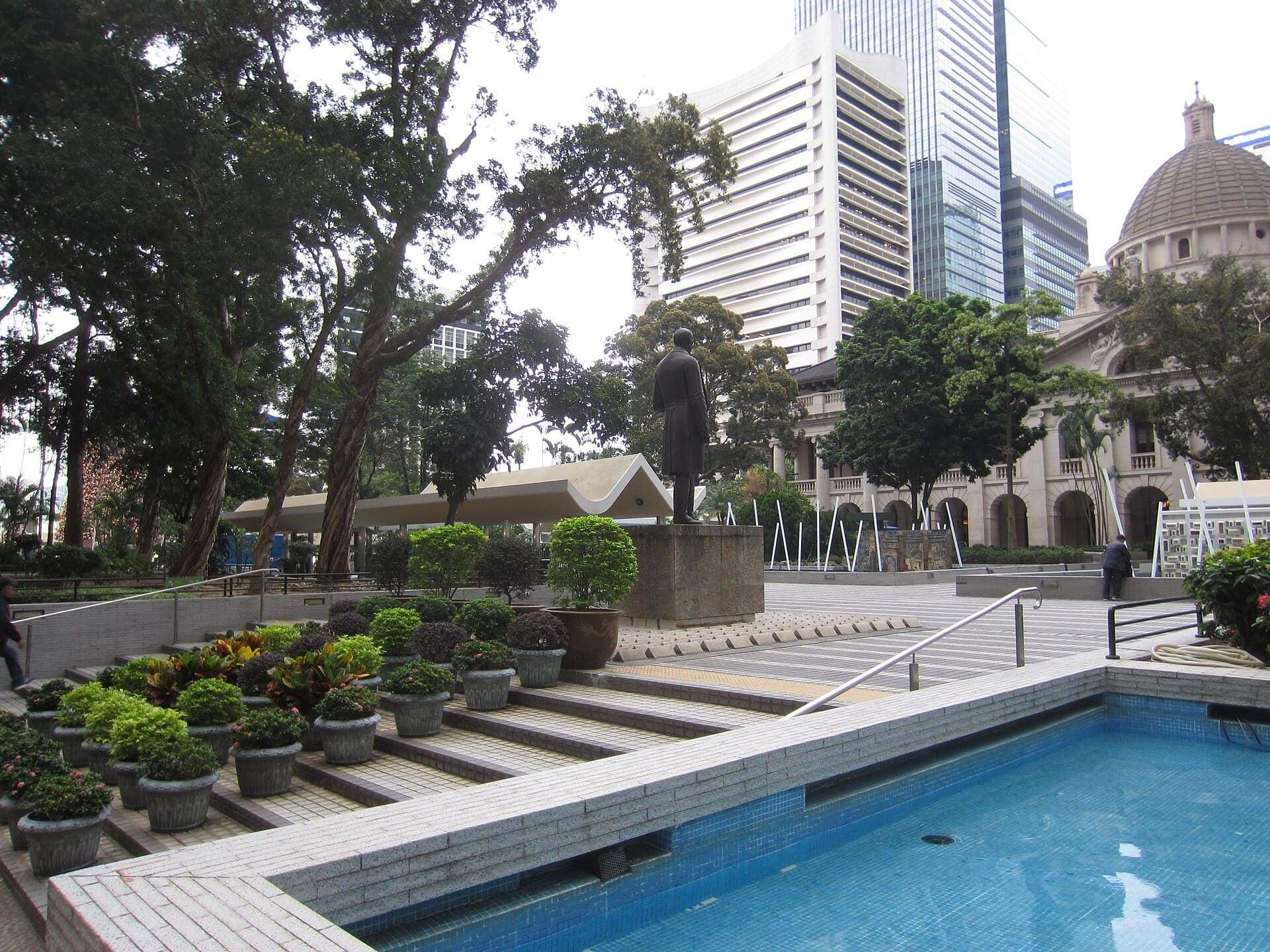
Statue Square (皇后像廣場)
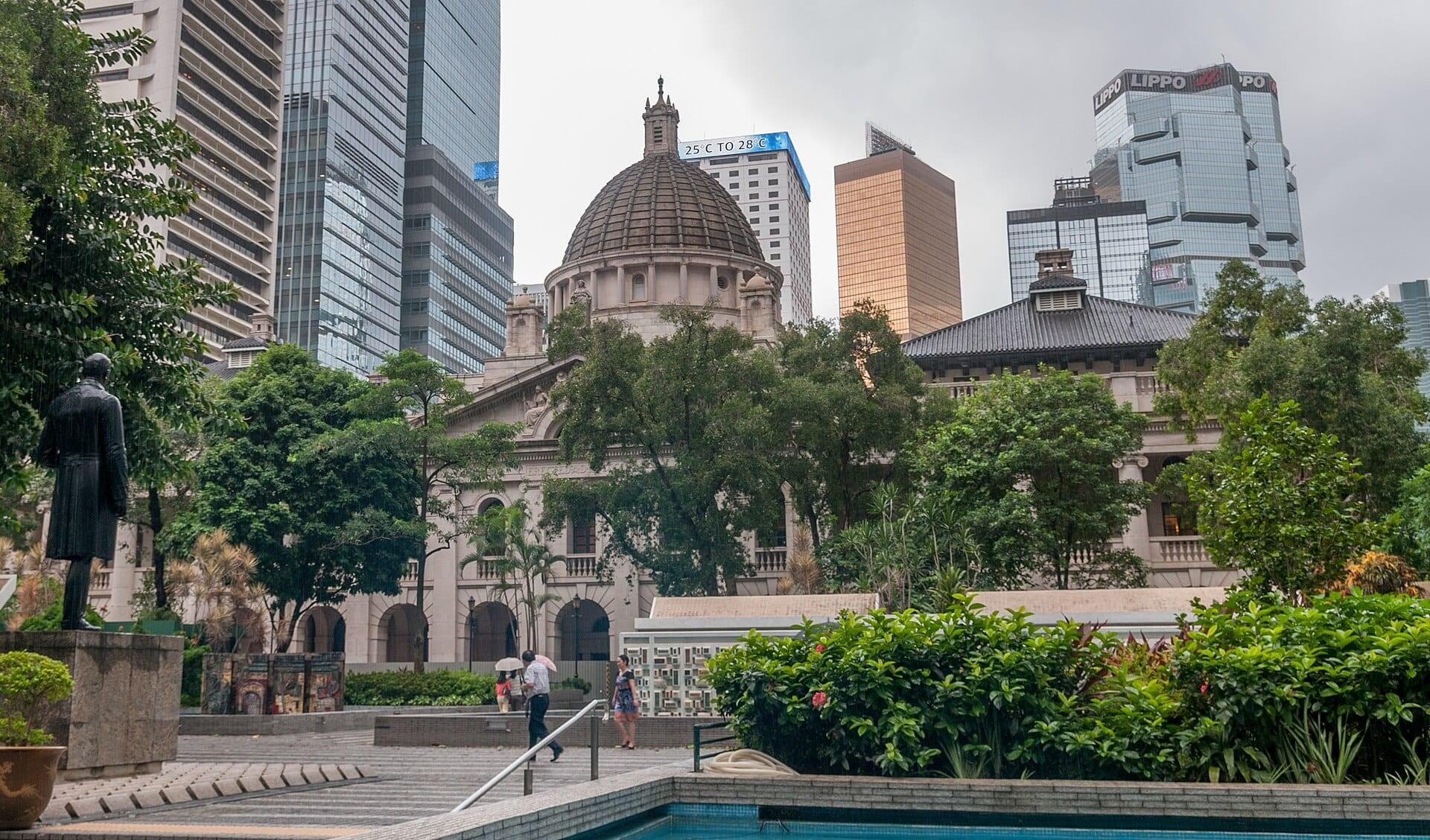
Ground that was harbor in 1889. Statue Square on Chater Road, laid out on the 1889 to 1903 reclamation, with the Cenotaph at its corner and the old court across the road.
- 2
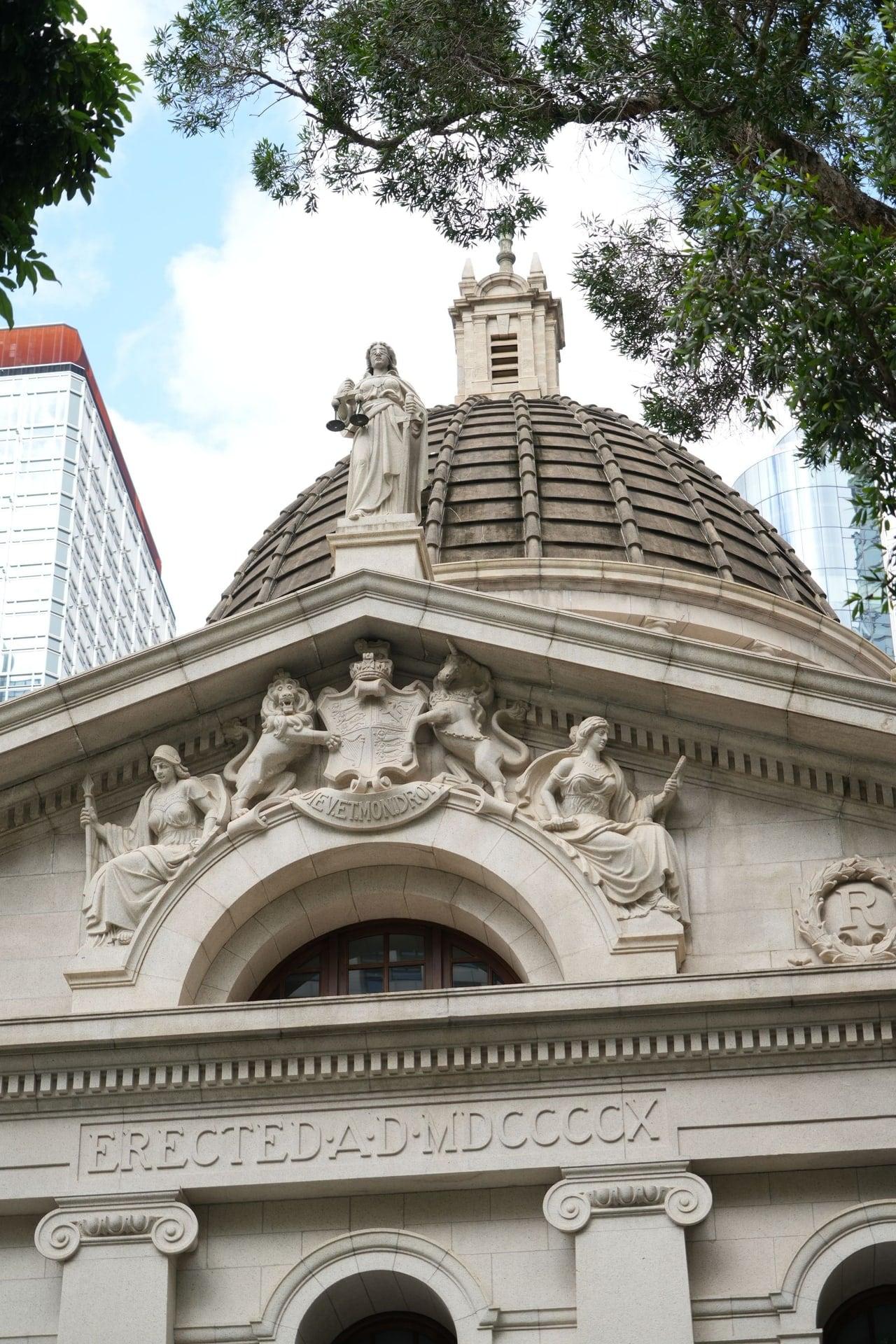
Court of Final Appeal (終審法院)
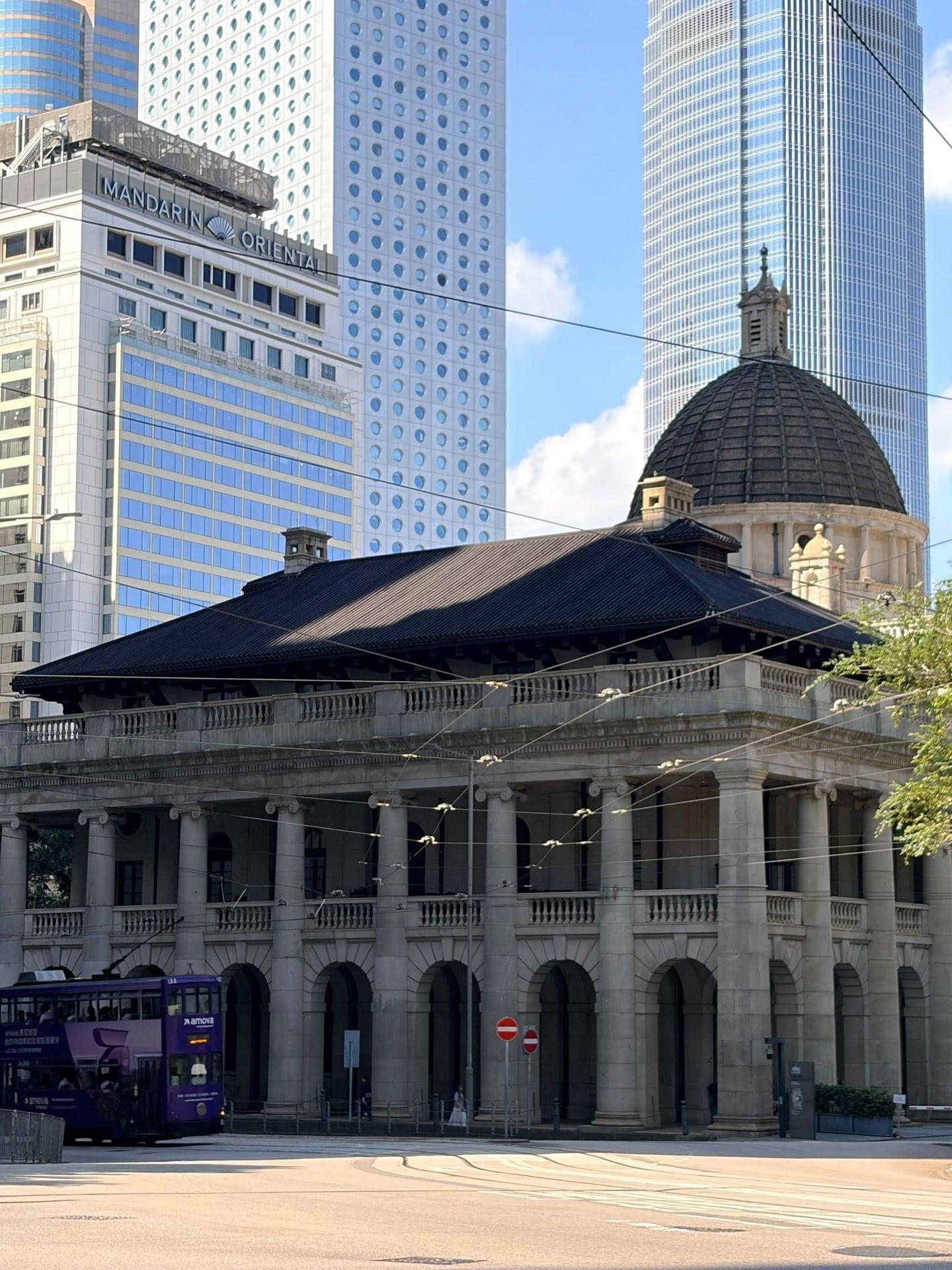
A granite court on fir piles. The Old Supreme Court of 1912, now the Court of Final Appeal, seen across Jackson Road from Chater Garden, the old cricket ground.
- 3
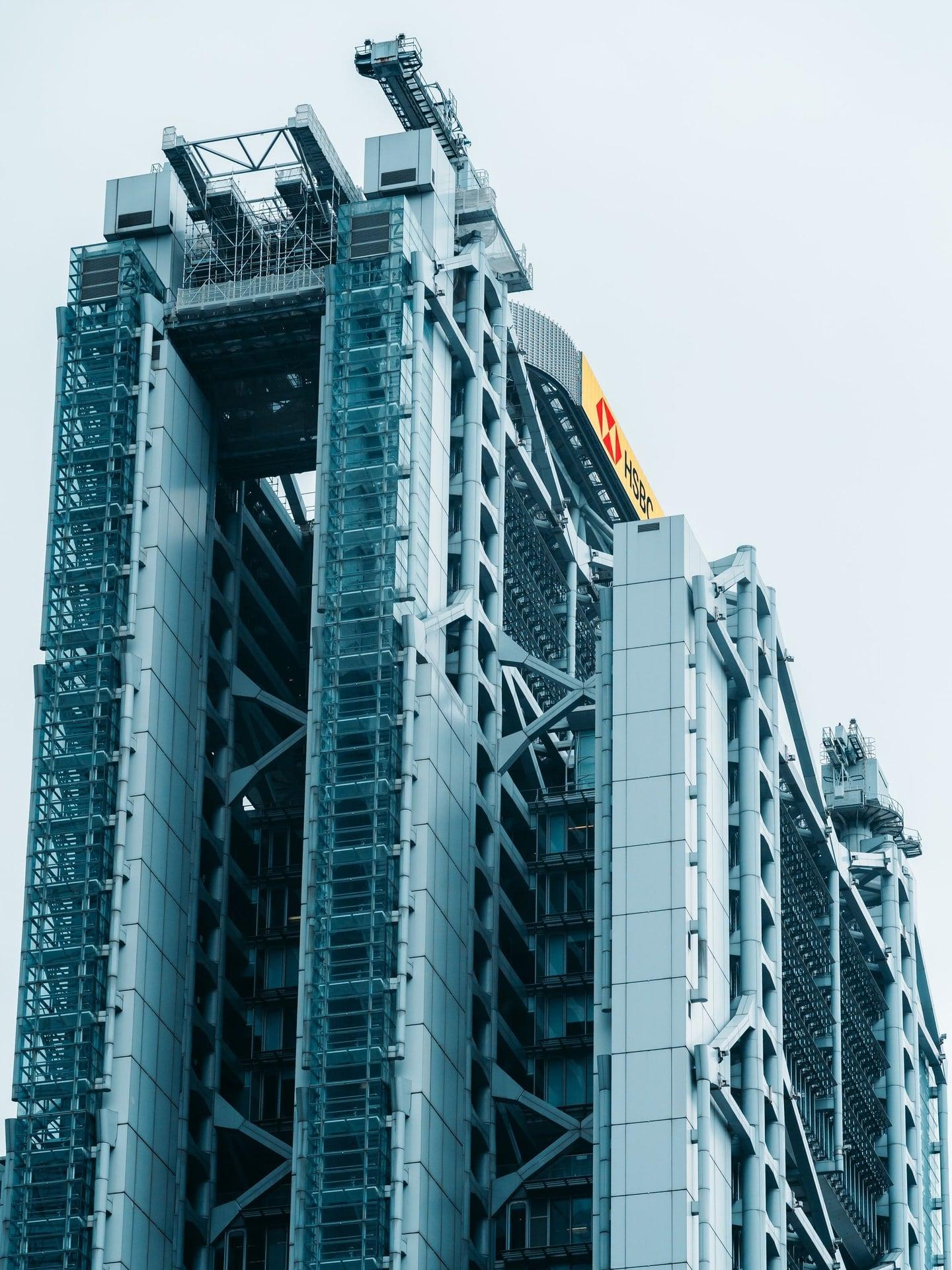
HSBC Main Building (滙豐總行大廈)
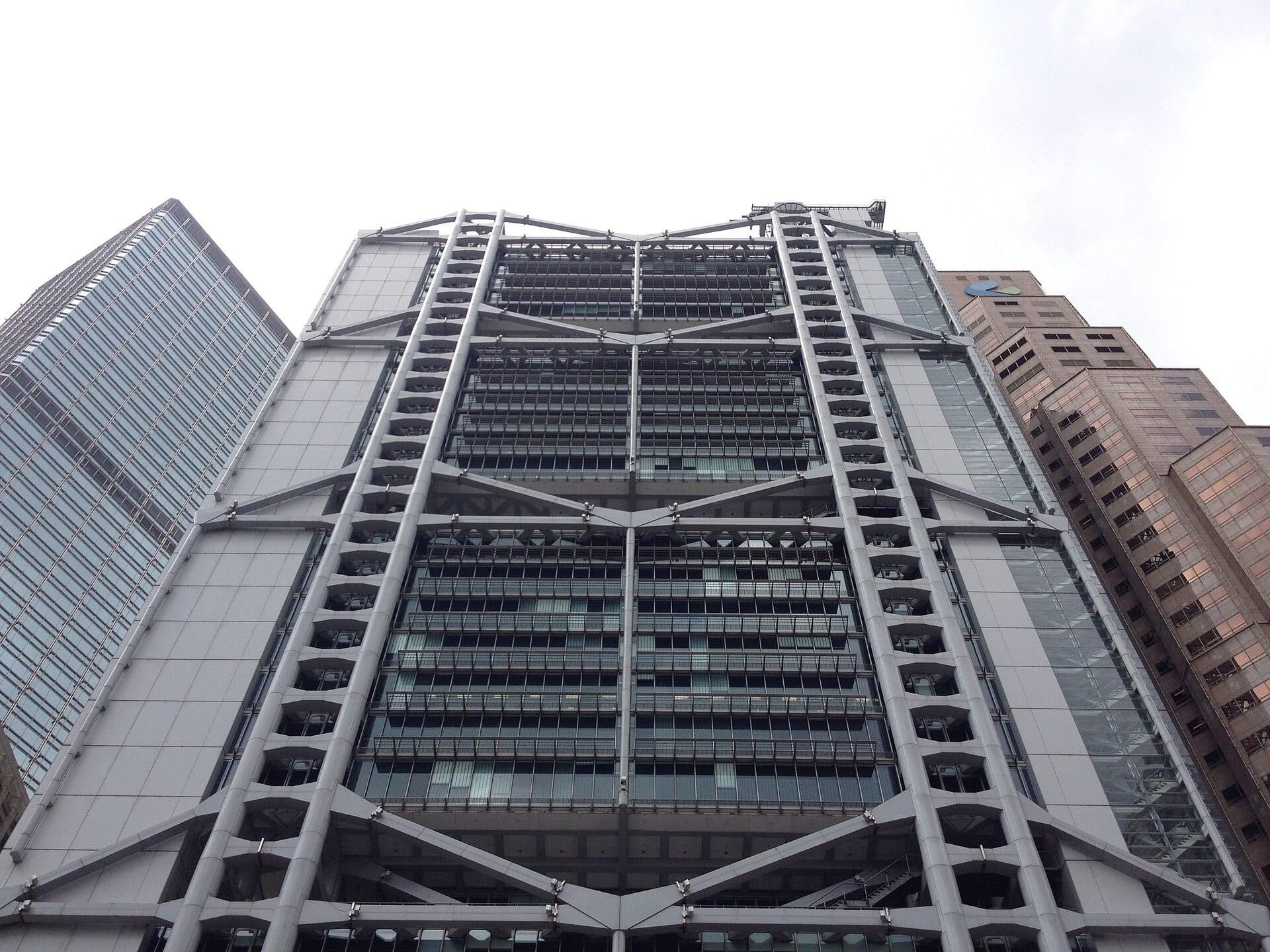
A bank that hangs from its masts. The 1986 HSBC Main Building from Des Voeux Road: steel masts, hanging floors and an open plaza you can walk through.
- 4
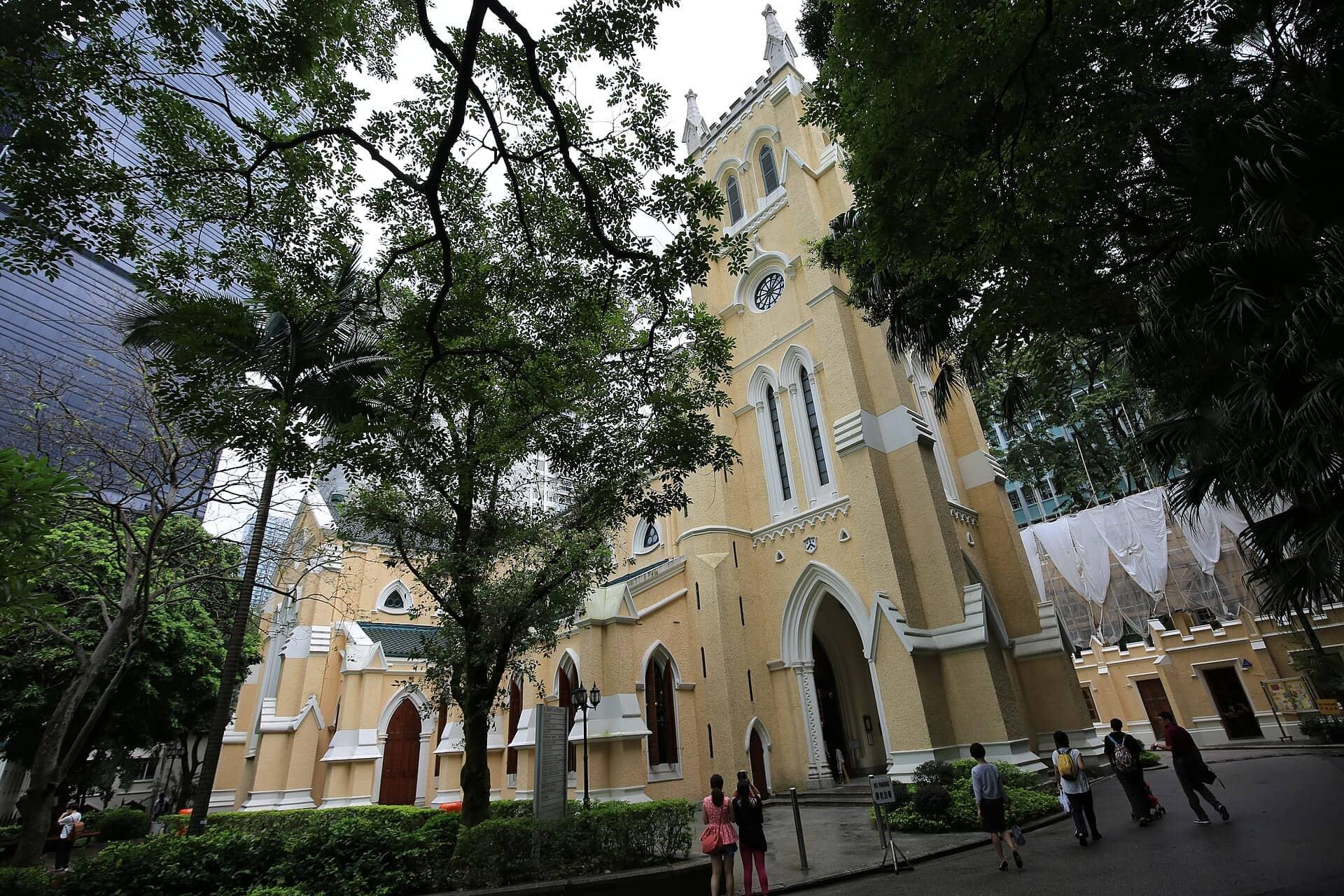
St John's Cathedral (聖約翰座堂)
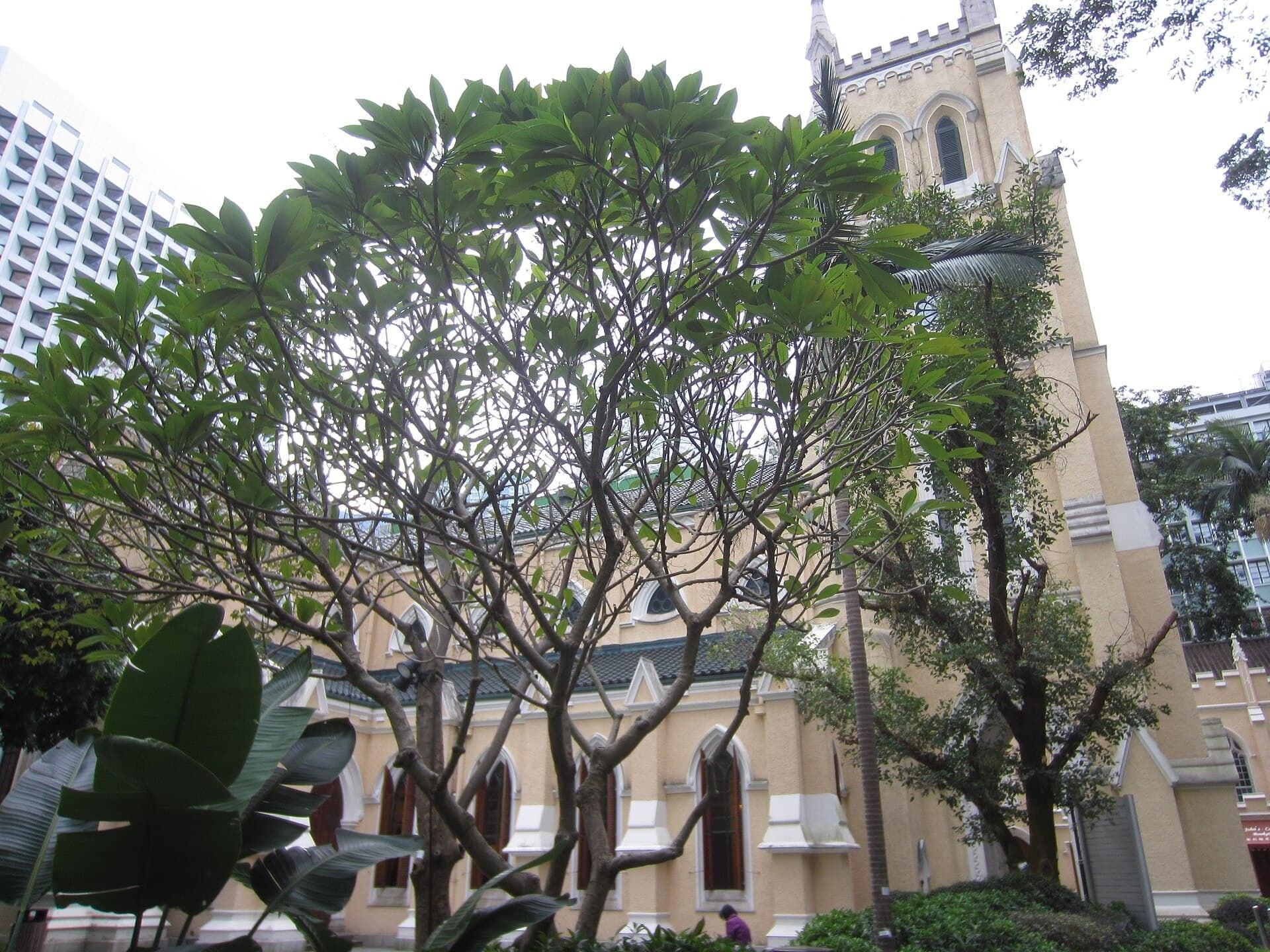
A soldiers' church built for heat. St John's Cathedral of 1849 from Battery Path, its notched tower and clover windows, with the Bank of China Tower above the garden.
- 5
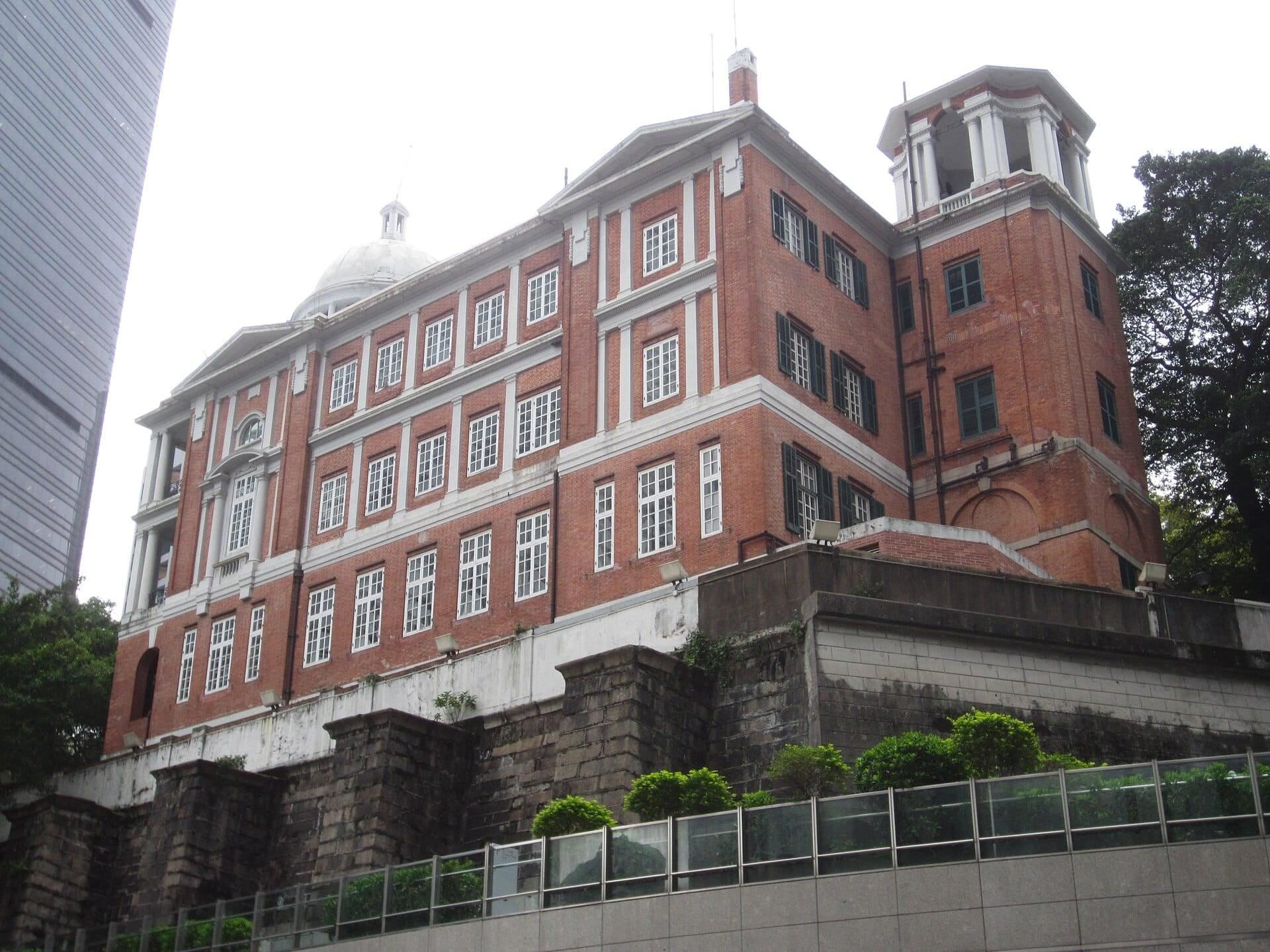
French Mission Building (前法國外方傳道會大樓)
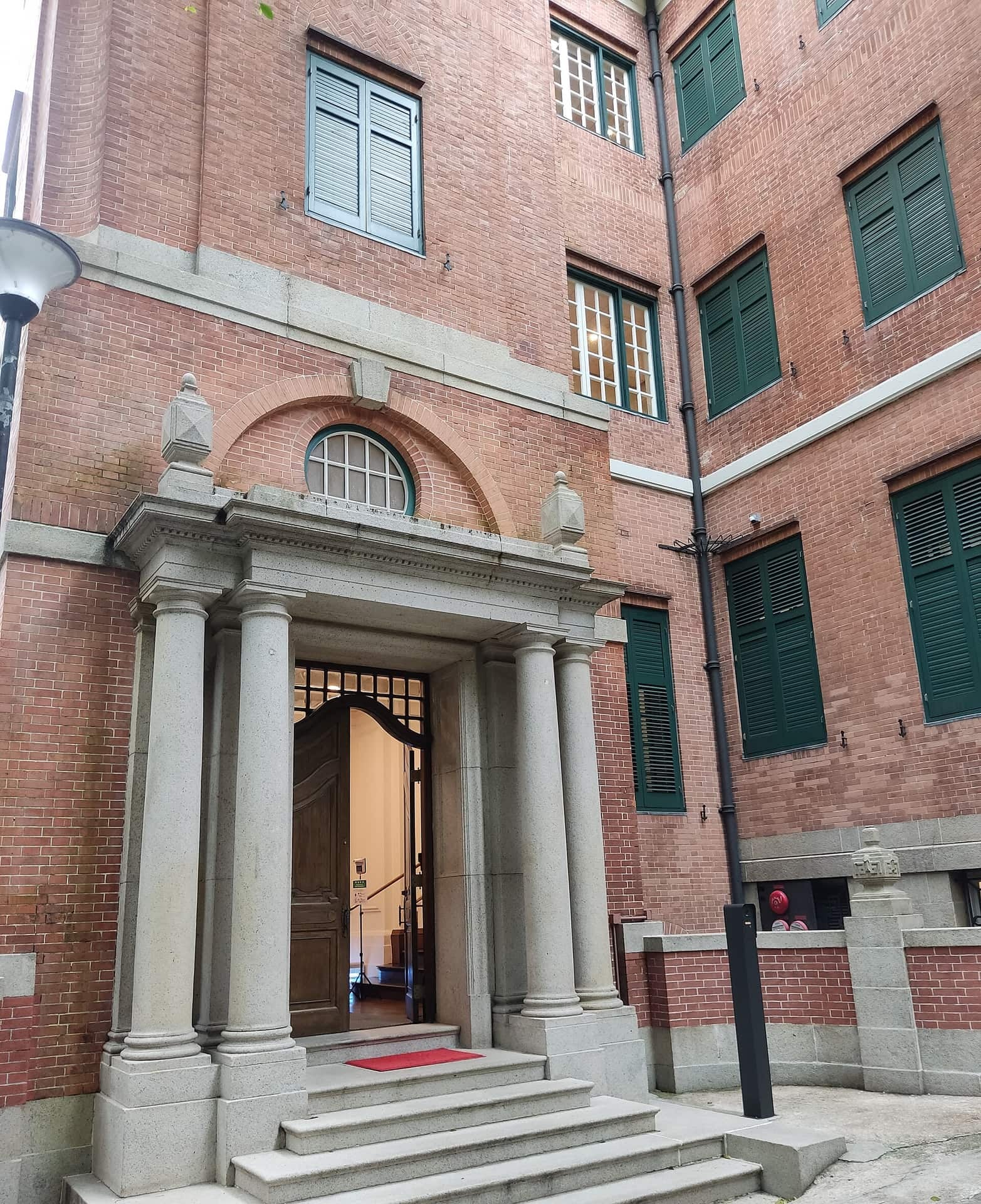
A mission's office with a chapel dome. The 1917 French Mission Building on Battery Path, granite and red brick, later offices and courts, now law organizations.
- 6
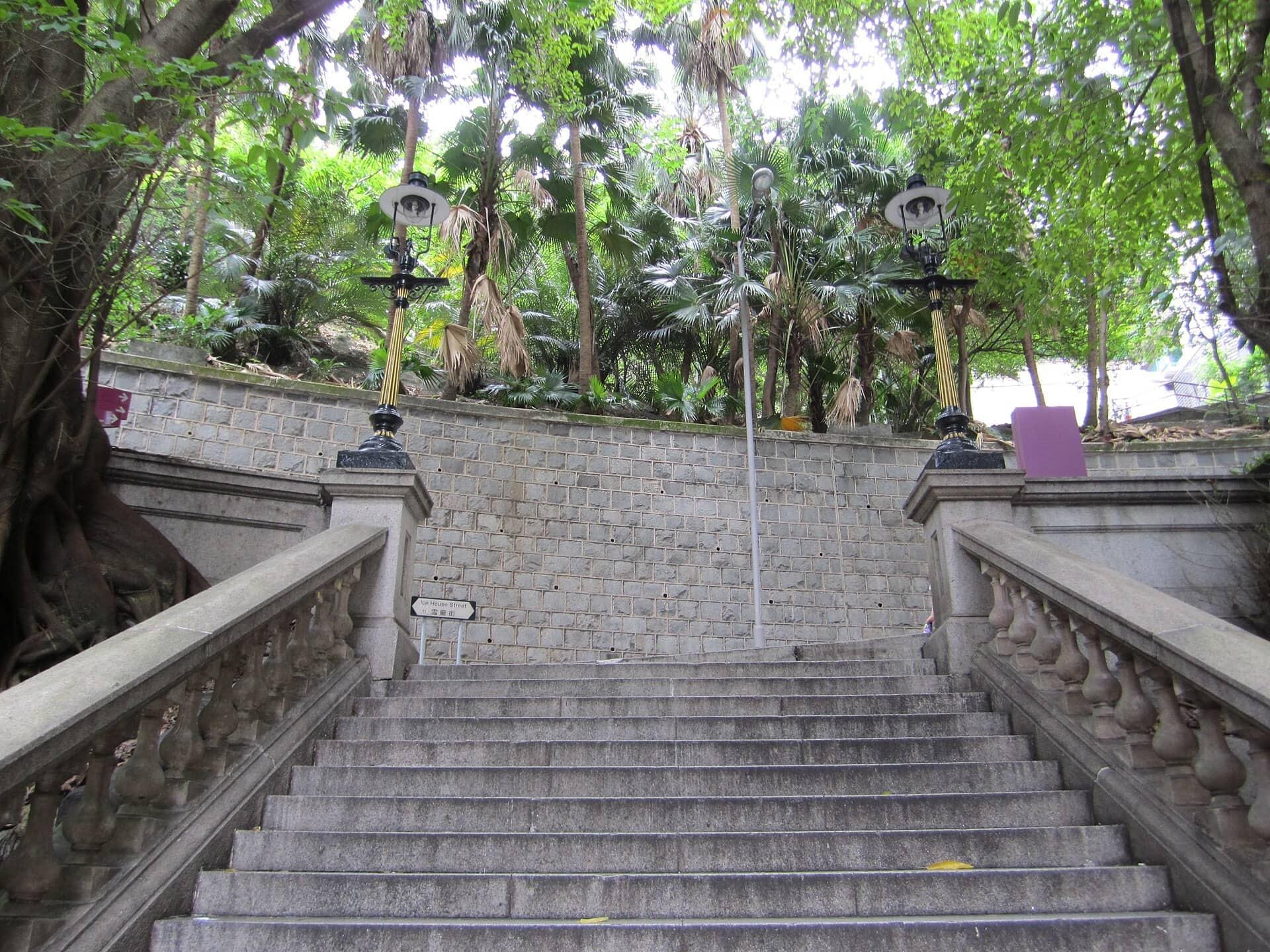
Duddell Street (都爹利街)
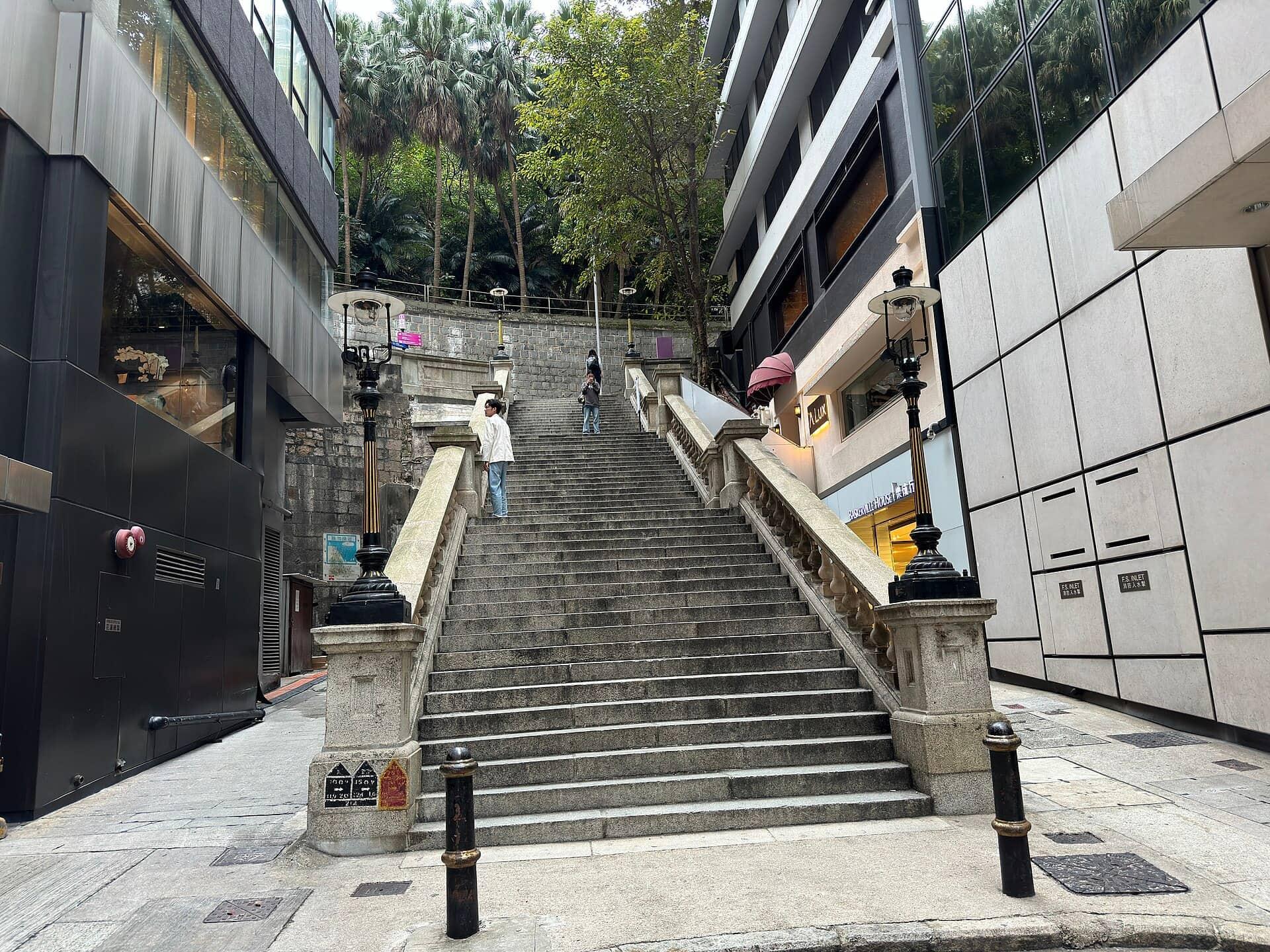
Four gas flames still light a street. The 1883 Duddell Street steps and their gas lamps, the city's last working ones, restored after Typhoon Mangkhut.
- 7
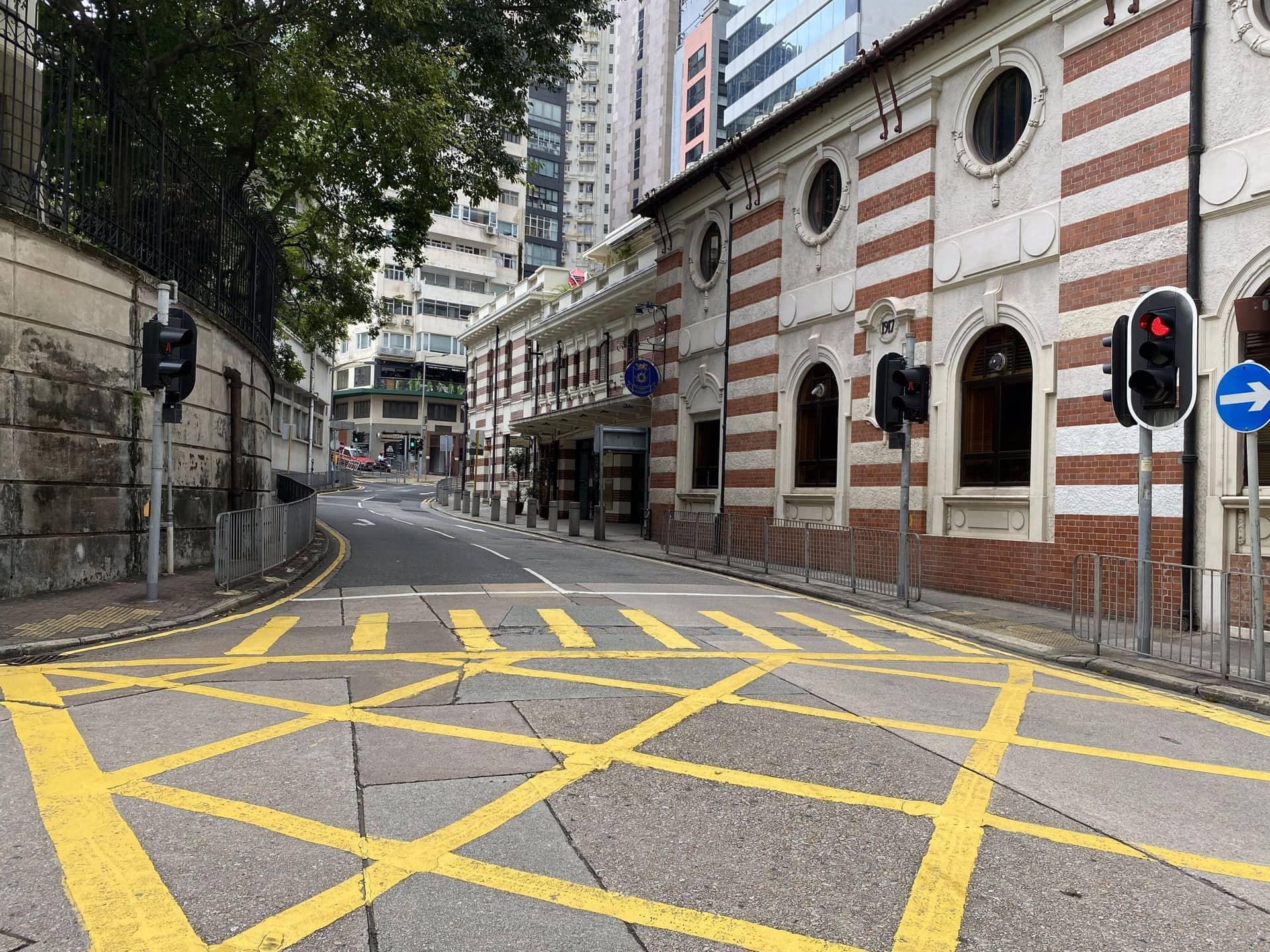
Old Dairy Farm Depot (舊牛奶公司倉庫)
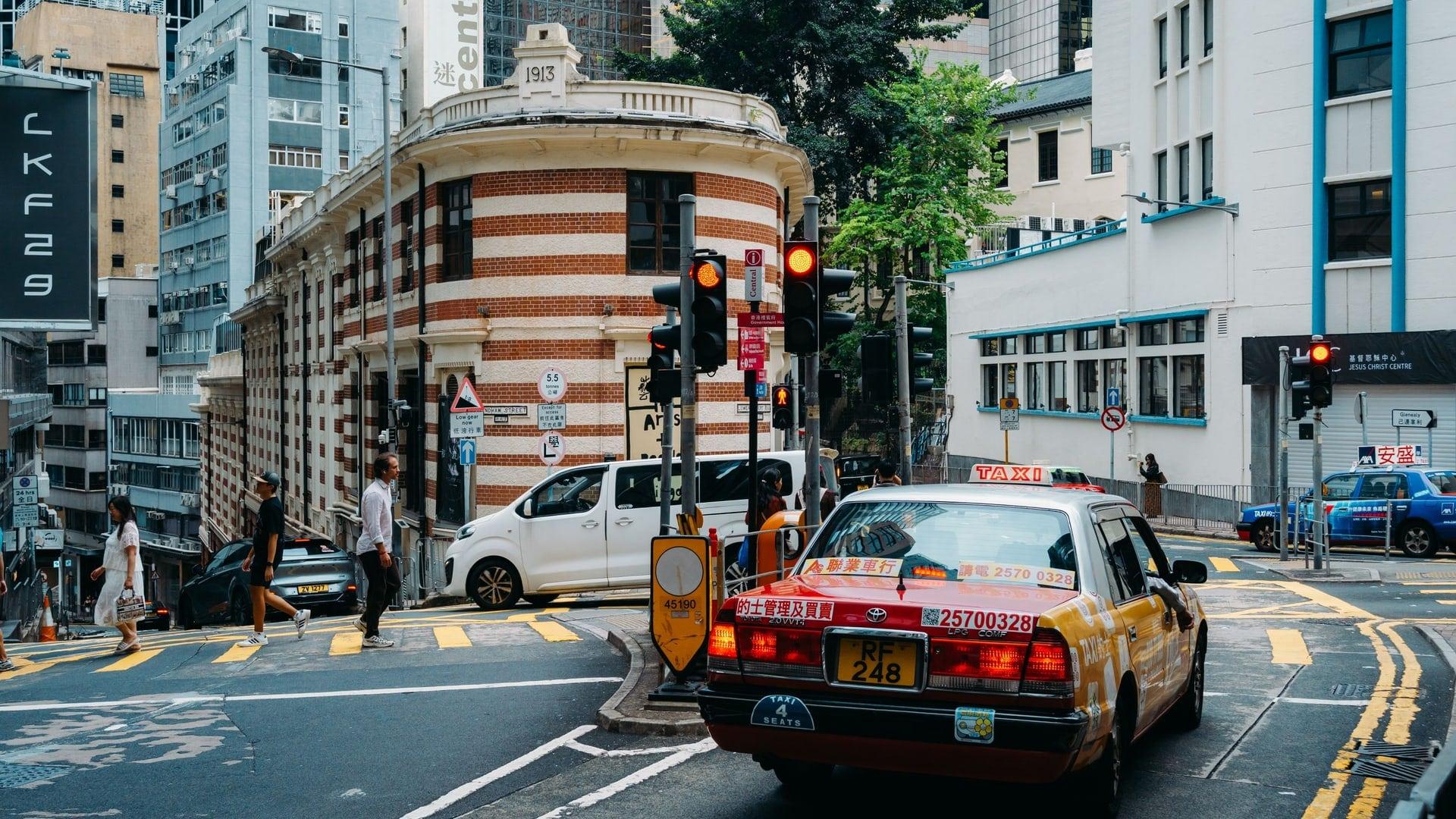
A milk depot in banded brick. The Old Dairy Farm Depot on Lower Albert Road, set up in 1892 to send out the dairy company's milk, in red and white banded brick.
- 8
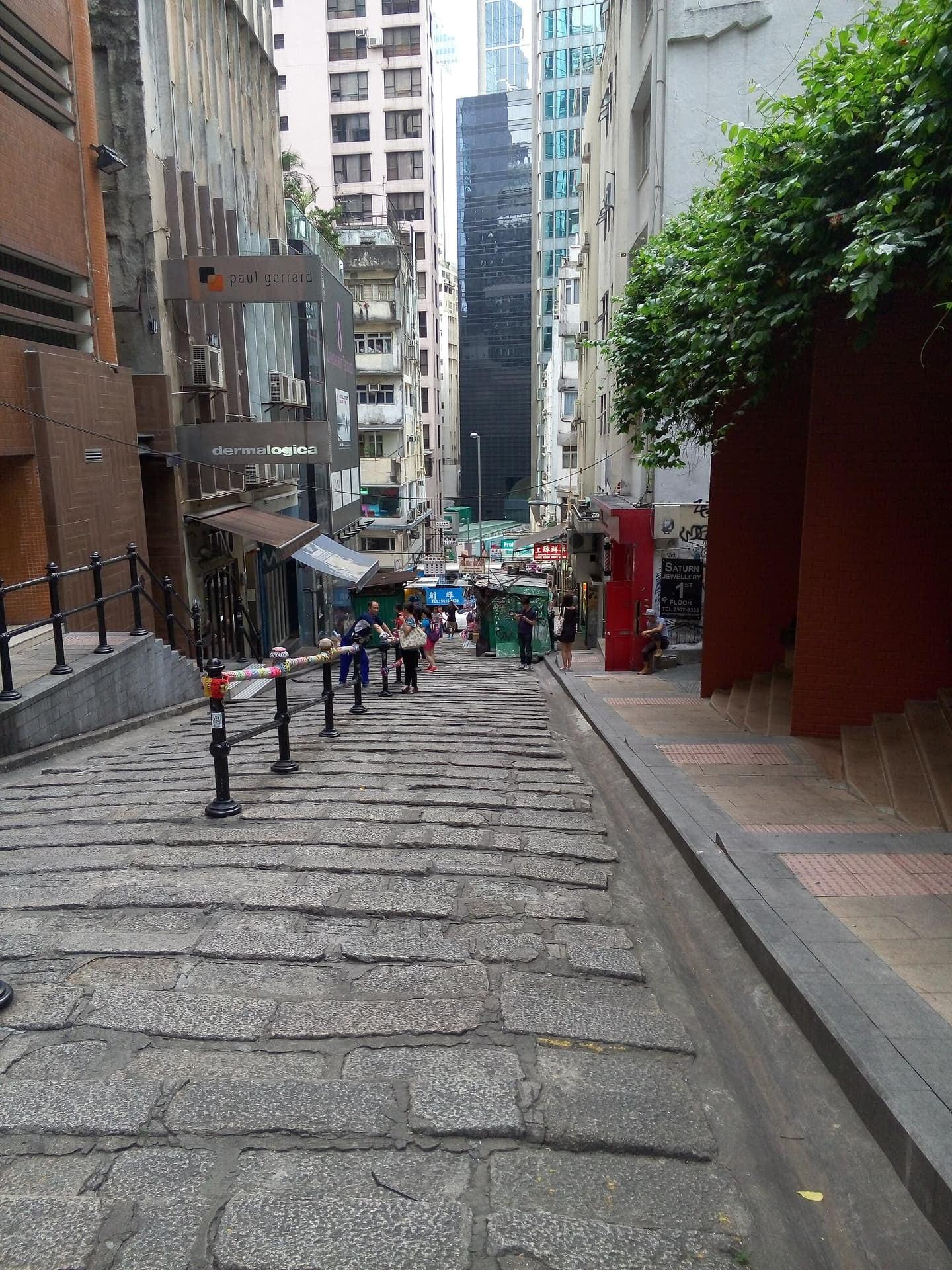
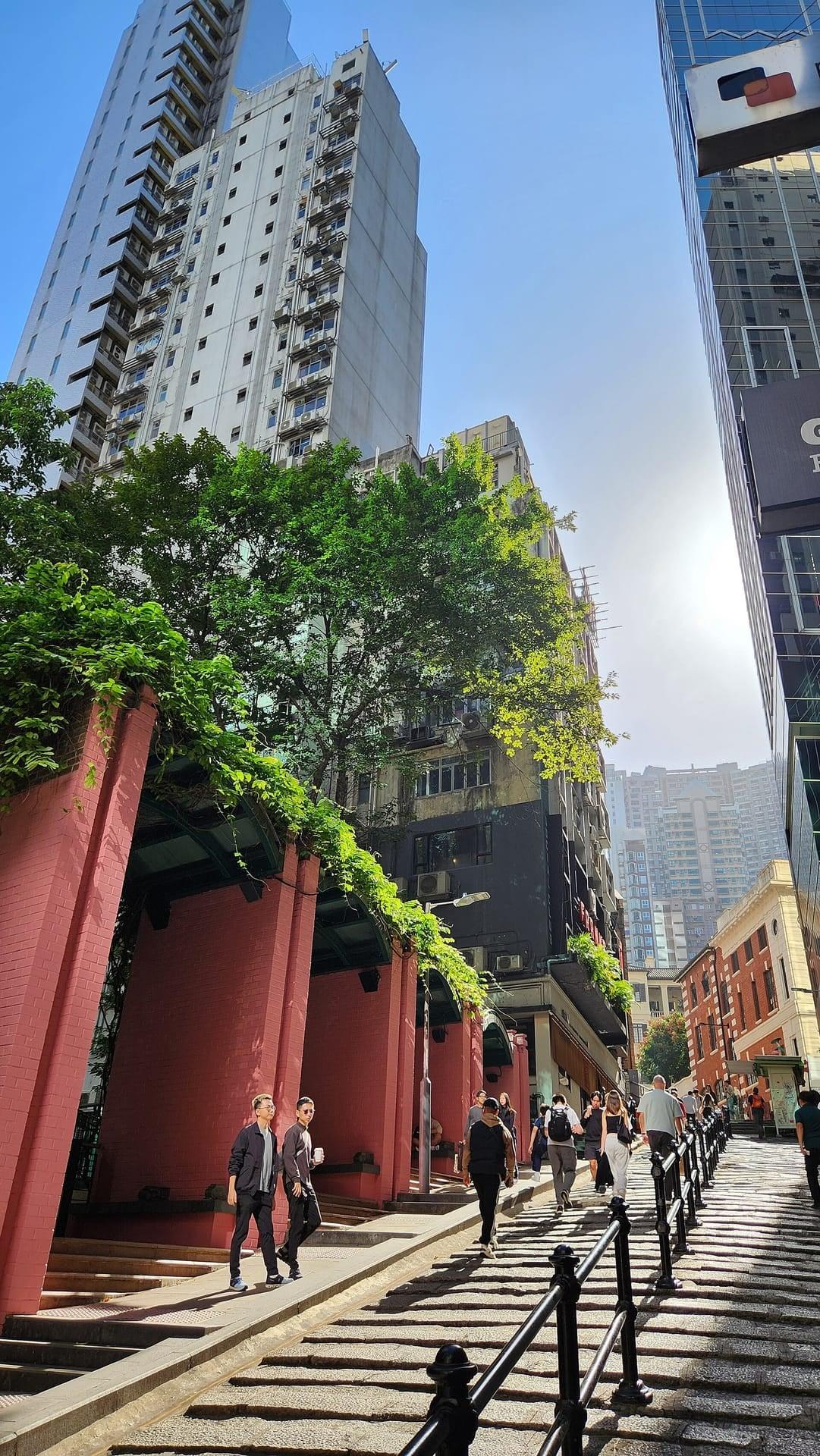
Pottinger Street (砵典乍街)
Stone slabs down to the first shore. Pottinger Street's rippled slab steps, one of Central's oldest streets, falling to Queen's Road, the 1841 waterfront.
- 9
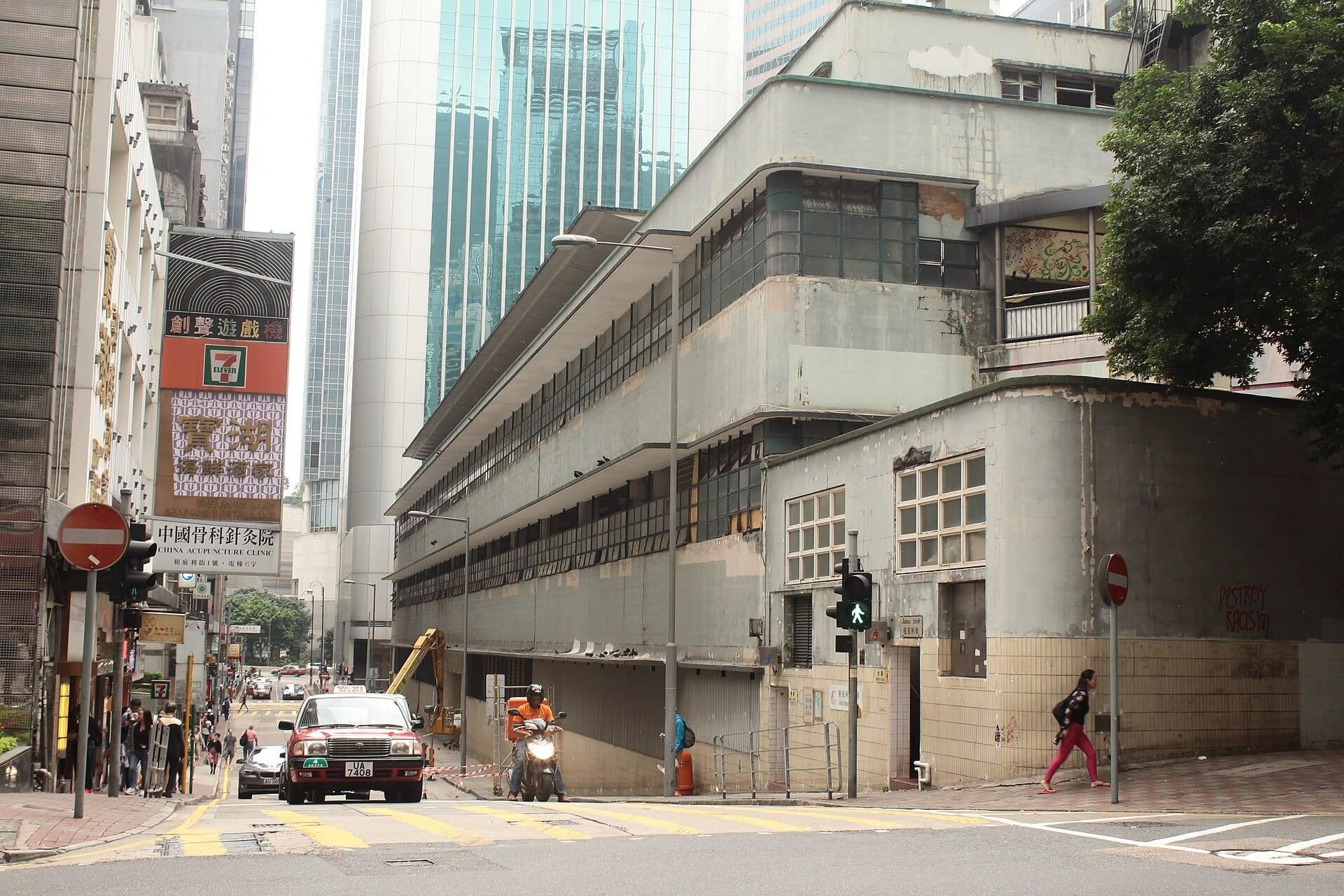
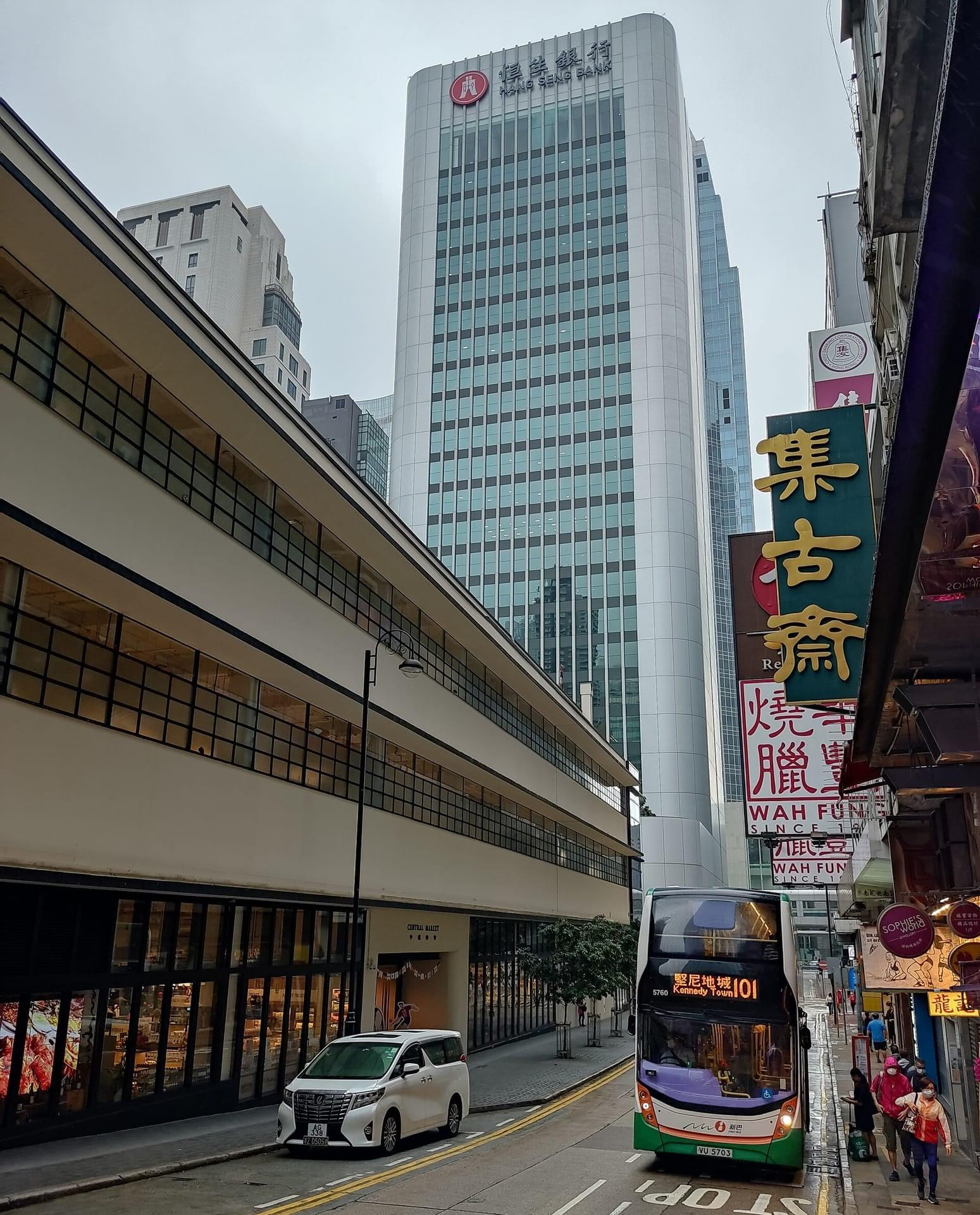
Central Market (中環街市)
A wet market built in streamlines. The 1939 Central Market on Queen's Road Central, Streamline Moderne, closed as a market in 2003 and reopened in 2021 and 2022.
- 10
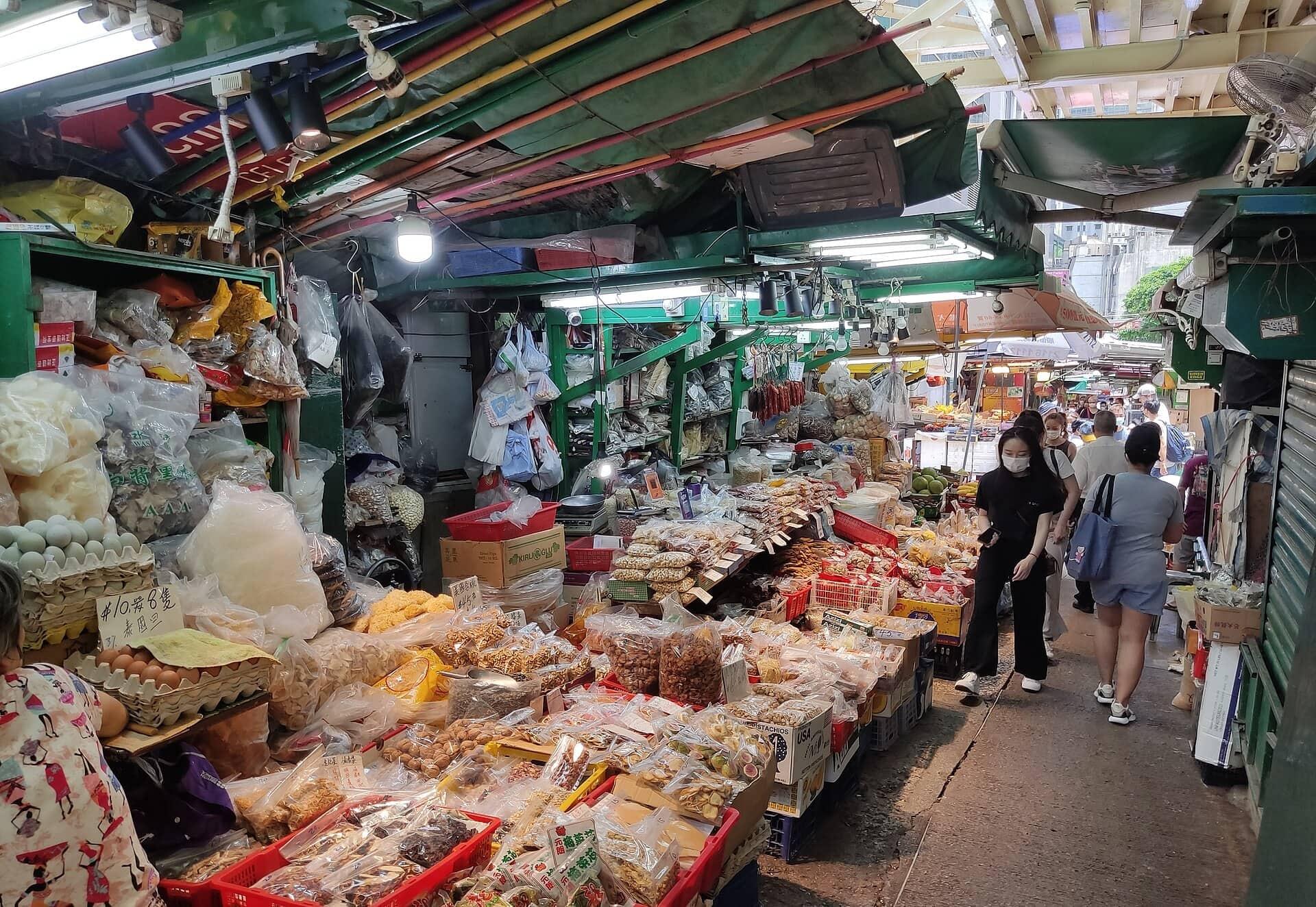
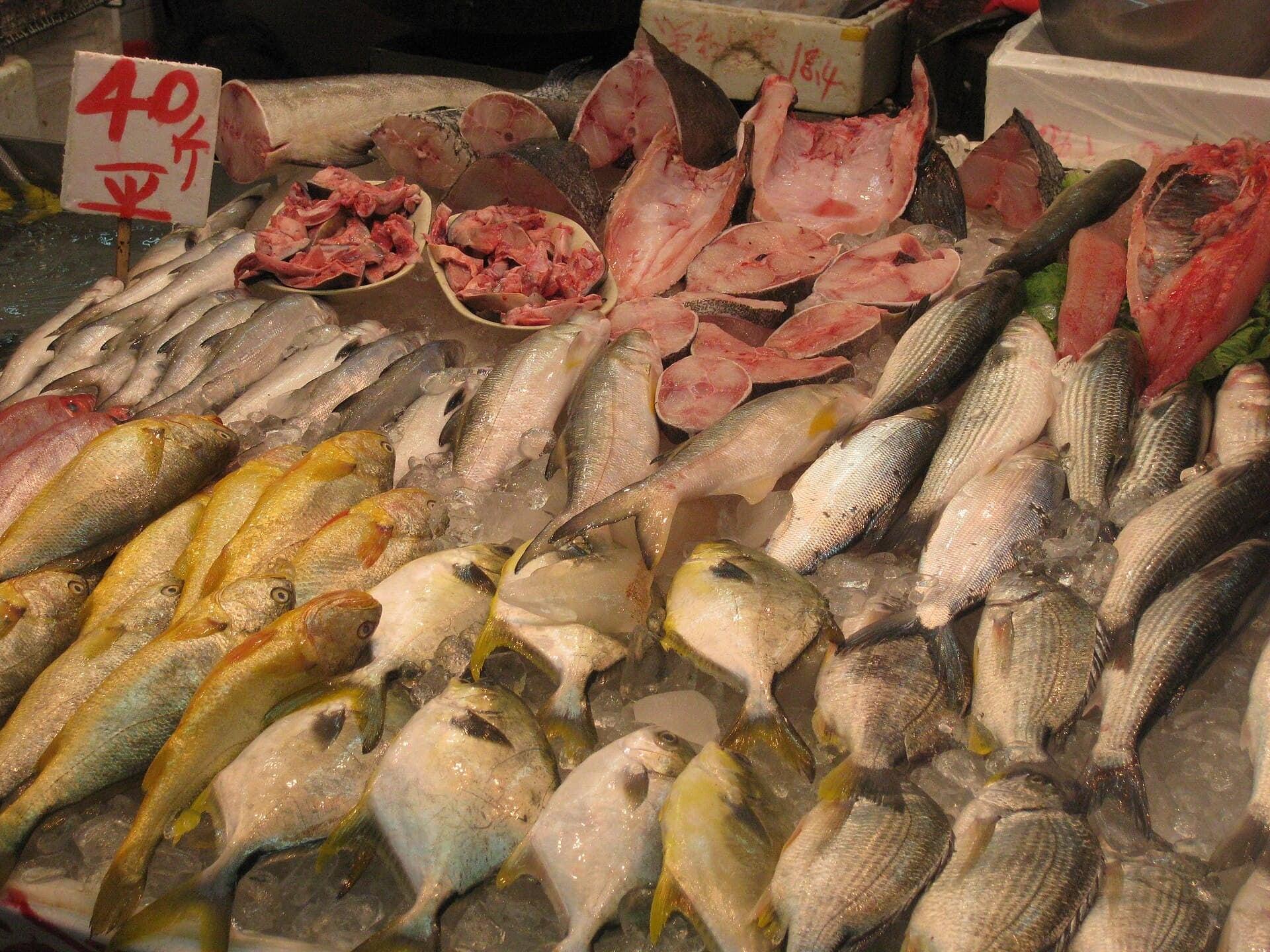
Graham Street (嘉咸街)
A market still trading in the street. Graham Street's open air wet market on a stepped street, more than a century old, with stalls under awnings.
- 11
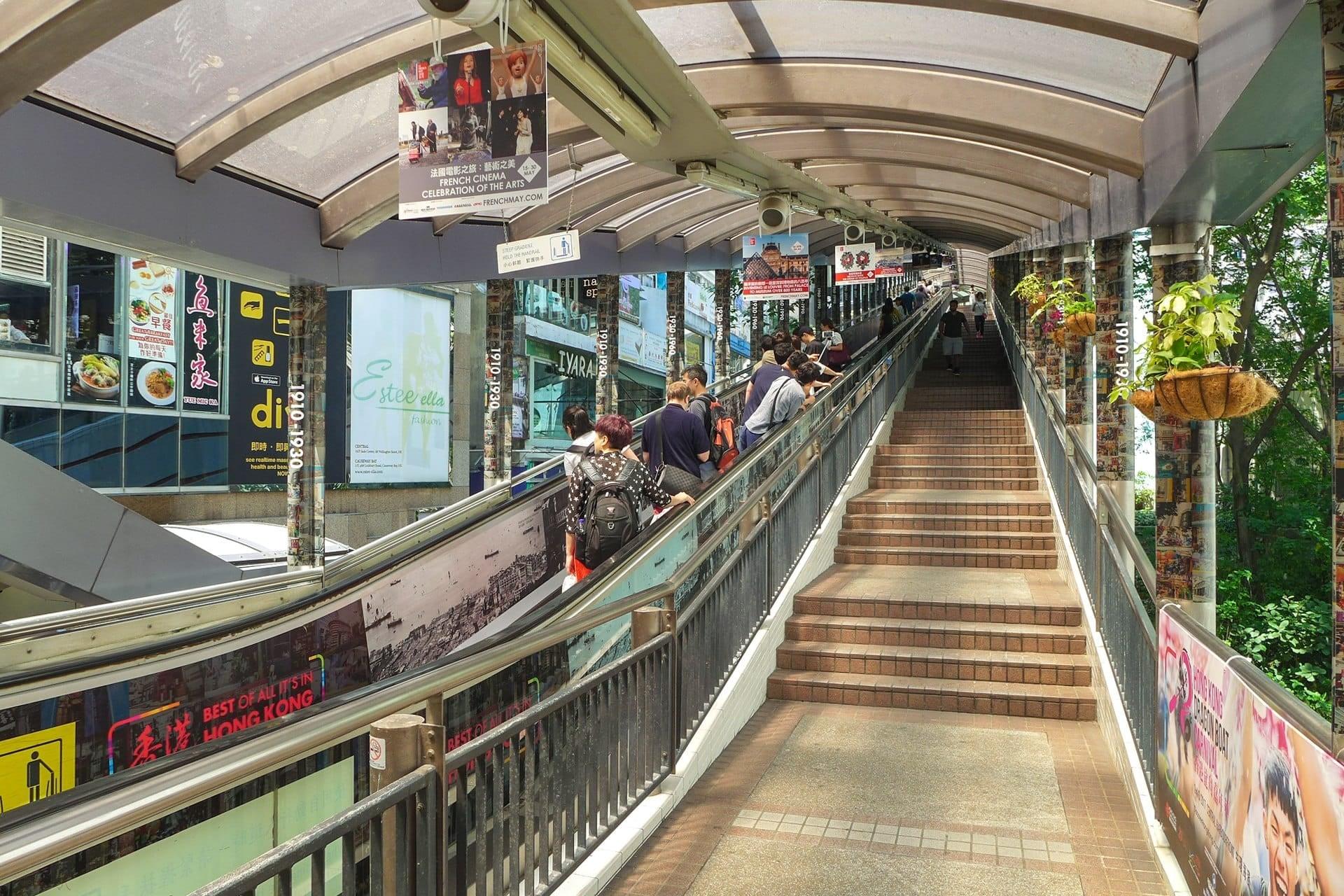
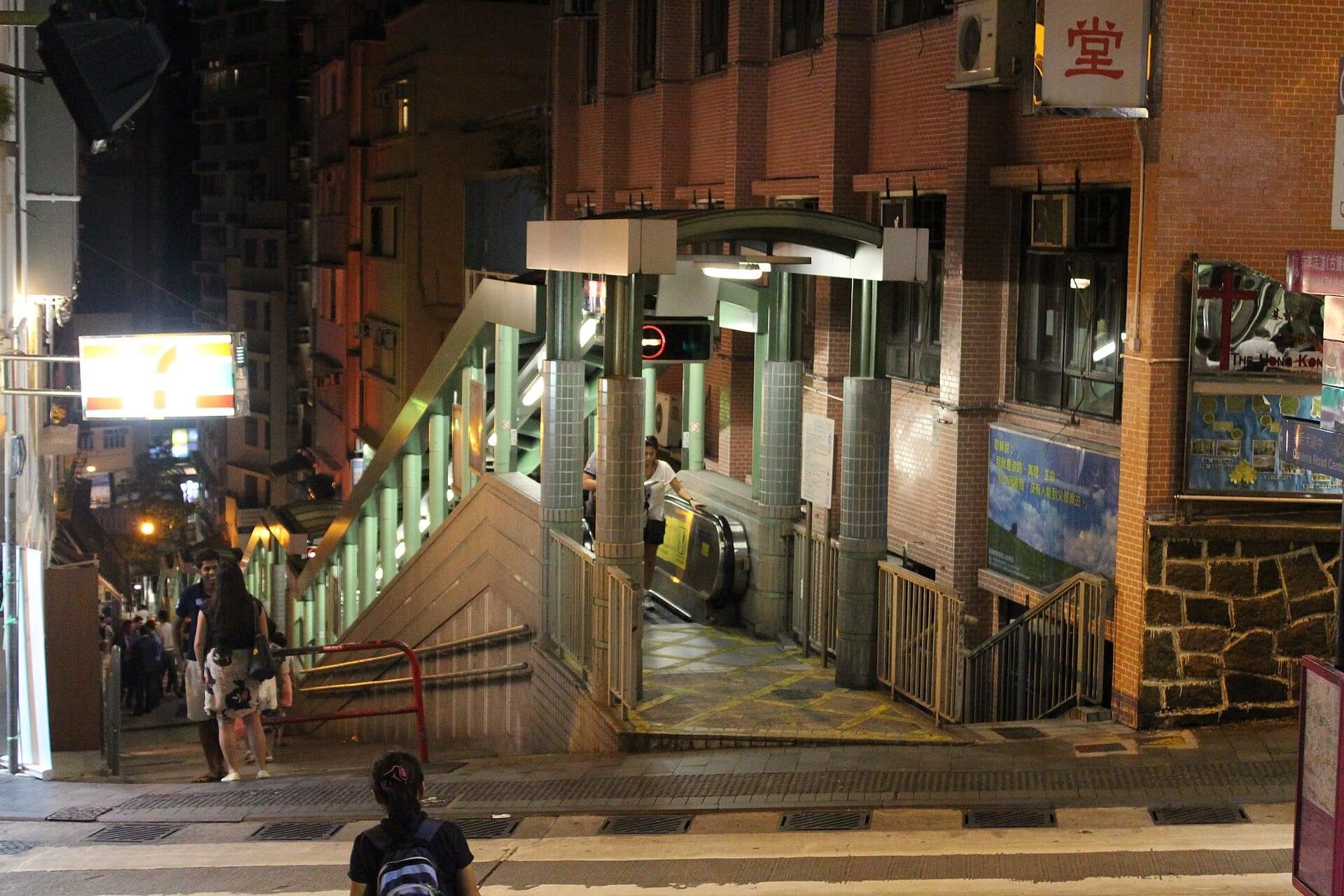
Mid-Levels Escalator (中環至半山自動扶手電梯)
A hillside commute that flips at ten. The 1993 Central to Mid-Levels Escalator crossing Hollywood Road: downhill in the morning, uphill until midnight.
- 12
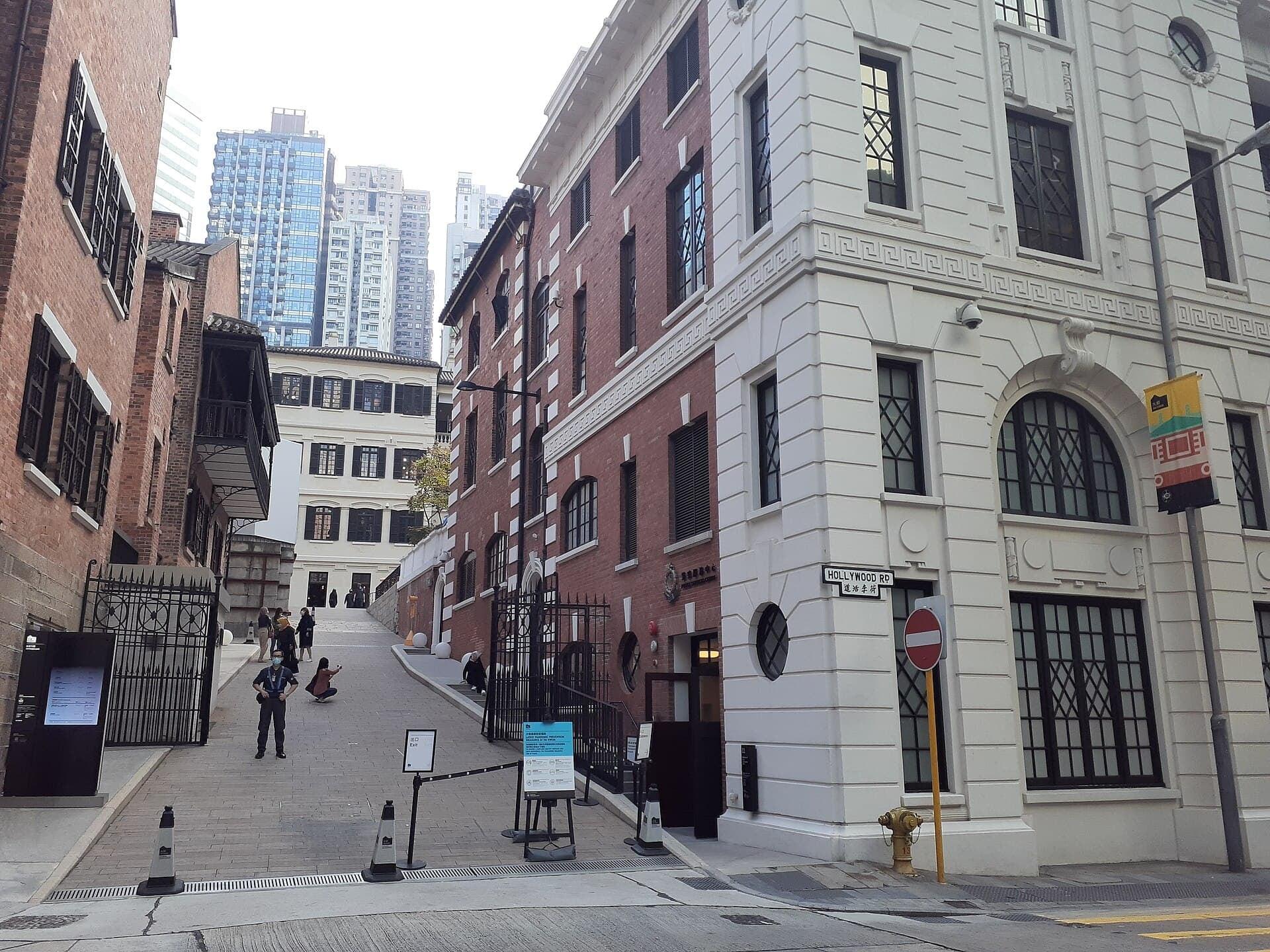
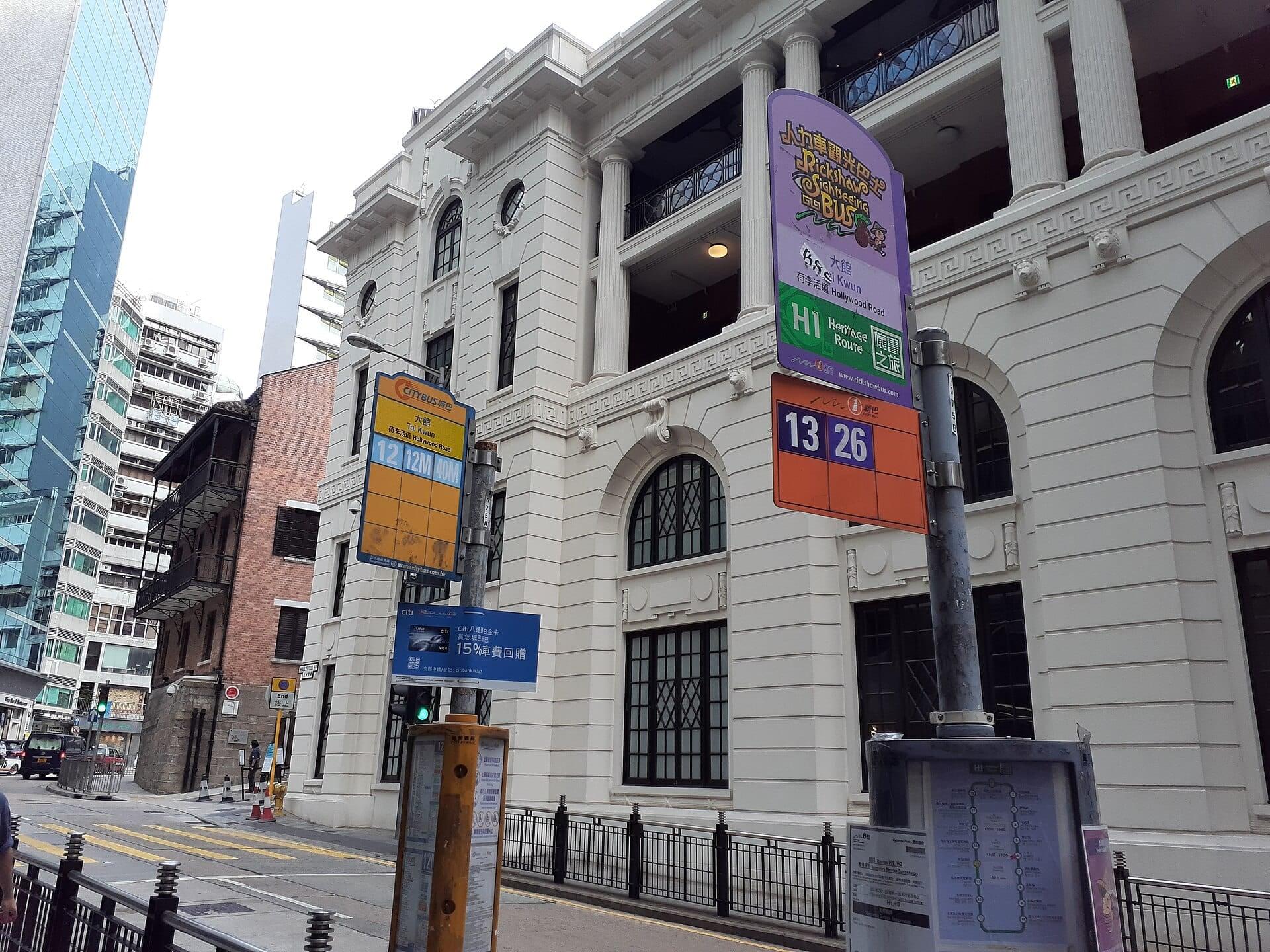
Tai Kwun (大館)
The police town on the hill, opened up. Tai Kwun's Parade Ground, between the 1864 Barrack Block and the 1919 Police Headquarters Block, now heritage and arts.
Details
Best Time to Visit
Any day, from morning to evening; about 90 minutes. Graham Street's market (stop 10) is busiest in the morning, and many stalls close for the first days of Lunar New Year (6 to 9 February 2027). The Duddell Street gas lamps (stop 6) burn after dark: December sunset 17:38 (1 Dec) to 17:50 (31 Dec), 18:00 on 15 January (Hong Kong Observatory). Tai Kwun (stop 12) is open 8am to 11pm. The escalator (stop 11) runs downhill 06:00 to 10:00 and uphill 10:00 to midnight. WinterFest's Hong Kong Winter Wonderland fills Statue Square Garden from 18 November 2026 to 5 January 2027 (weekdays 16:00 to 23:30, weekends 11:00 to 23:30), with a light show projected on the Court of Final Appeal, HSBC and the Bank of China buildings from 19:00 to 23:00 every 30 minutes (HKTB, 11 November 2026): the stops are on the pavement outside it, but evenings and weekends are crowded. Statue Square and the HSBC plaza are also crowded on Sundays and public holidays; check for event closures on public holidays, and expect crowds round Central on New Year's Eve. Do not walk under a No. 8 typhoon signal or a black rainstorm warning. Checked 25 November 2026.
Pro Tips
- •Getting to the start: MTR Central station, exit K (Statue Square), per the MTR's Central street map (November 2026). Trams on Des Voeux Road Central also stop by the square: adult fare HK$3.30, board at the back, pay as you leave at the front by Octopus, contactless card or cash (no change). Checked 25 November 2026.
- •The walk ends inside Tai Kwun on Hollywood Road. Back to MTR Central: the escalator runs downhill until 10:00; otherwise walk down Pottinger Street to Queen's Road Central, about 10 minutes. Sheung Wan's walk starts at PMQ, about 5 minutes west along Hollywood Road.
- •No ticket is needed for any stop. St John's Cathedral, the Central Market and Tai Kwun's galleries are optional visits; check the cathedral's opening hours at the door, and keep quiet during services.
- •The Peak Tram's lower station is on Garden Road a short way above St John's Cathedral (stop 4), if you want to go up the Peak afterward; the MTR lists bus 15C from exit K for it.
- •GPS can drift between the towers at stops 3 and 9 and in the narrow streets at stops 8 and 10; if a stop has not started, tap it on the map. At Tai Kwun the stop also plays at the Hollywood Road gate when the site is shut.
- •Step-free alternative to Pottinger Street's steps (stops 7 to 9): from the Lan Kwai Fong lanes keep down D'Aguilar Street to Queen's Road Central and turn west to the Central Market, then play stop 8 by hand.
Safety & Precautions
- •Hong Kong drives on the left, but many side streets in Central are one-way: look the way the traffic comes. The directions name the side at each unsignalled crossing (Jackson Road and the Cheung Kong Center driveway from the left; Ice House Street's service entry, Stanley Street and Wellington Street at Pottinger Street from the right; Gage Street, Lyndhurst Terrace and Wellington Street at Graham Street from the left).
- •Leg 3-4 crosses Des Voeux Road Central's two tram tracks at the signals. Trams are quiet and run both ways; stay on the pavement at stop 3.
- •Stone steps: a short flight into Chater Garden, Duddell Street's 19 granite steps between stone balustrades, and Pottinger Street's two slab flights (the lower one 59 steps). They are uneven and slippery when wet; take them slowly.
- •At stop 8 stand on the landing, not in Stanley Street; cross it only when it is clear.
- •Lan Kwai Fong's lanes (leg 7-8) are packed on Friday and Saturday nights and on New Year's Eve; keep bags closed.
- •If a No. 8 typhoon signal or a black rainstorm warning is up, do not walk: wait until it is lowered. Tai Kwun closes for black rain issued before 8am. Checked 25 November 2026.
- •Graham Street is a working market: ask before photographing stallholders and step aside for handcarts.
Gallery
Read the walk
The full story of Central: Built on the Harbor, Climbing the Hill, in words. Prefer to listen? Play it narrated, from home or on location.
Introduction
Central is where Hong Kong's first city began, on a strip of shore between the harbor and a steep hill, and the shore has not stayed put. The road that ran along the water in eighteen forty one is now well inland, and the square where this walk starts was sea until the end of the eighteen eighties. The walk climbs from that new ground, past two banks, a court and a cathedral, up stone step streets and through a street market, to the old police compound on Hollywood Road.
There are twelve stops over about two and a half kilometers, about one and a half miles, and it takes about ninety minutes. The first stretch is flat. After that the route climbs, drops and climbs again, with several flights of stone steps that are steep in places and slippery when wet.
Traffic in Hong Kong keeps to the left, but many side streets here are one-way, so look the way the traffic comes; each crossing that matters is described as you reach it. Early on you cross the tram tracks on Des Voeux Road at the lights: the trams are quiet and run both ways.
No ticket is needed for any stop. Going into the cathedral, the market hall or Tai Kwun's galleries is optional. Tai Kwun's courtyards, at the end, are free and open from eight in the morning to eleven at night.
Winter days are mild, about twenty degrees Celsius, sixty eight Fahrenheit. If a number eight typhoon signal or a black rainstorm warning is up, do not walk: wait until it is lowered.
To reach the start, take the MTR to Central station and use exit K, for Statue Square. When you arrive at Statue Square, begin with stop one.
1. Statue Square (皇后像廣場)
This open square of pools and planting is Statue Square, and the ground under your feet was harbor until the end of the eighteen eighties.
Hong Kong's first shore ran along Queen's Road, a few blocks inland from here, at the foot of the hill. Later the water's edge was pushed out to the street where the trams now run, on the far side of the square. Then, in eighteen eighty seven, a businessman named Paul Chater proposed to reclaim a long strip of seabed along the city's whole front, fifty eight point seven acres of it. The Hong Kong Memory heritage project calls it the largest reclamation scheme of its time. Work began in eighteen eighty nine and finished in nineteen oh three. Its new waterfront became Connaught Road, the big road on the harbor side, and on the new land rose this square, the Hong Kong Club, Prince's Building and the court building across the road. Two of the streets you cross on the way up the hill, the tram street and Queen's Road, were each the shore in their turn.
The square's Chinese name means Queen's Statue Square.
At the corner where you will cross stands the Cenotaph. It was unveiled on the twenty fourth of May, nineteen twenty three, and Hong Kong's Antiquities and Monuments Office calls it the earliest memorial formally built in Hong Kong for the dead of the First World War. It first carried the words The Glorious Dead and the years of that war. The years of the Second World War were added later, and in the nineteen eighties eight Chinese characters were carved on one side, meaning: may their martyred souls be immortal, and their noble spirits endure.
Follow the route across Chater Road at the lights by the Cenotaph, across Jackson Road at the next lights, and up a few steps into the garden.
2. Court of Final Appeal (終審法院)
You are in Chater Garden. Across Jackson Road stands a grey granite building lined with tall Ionic columns. High on its central section, on top of the pediment, stands a blindfolded figure of Justice, in the form of the Greek goddess Themis.
This is the Old Supreme Court building. It was opened on the fifteenth of January, nineteen twelve, and the Antiquities and Monuments Office records how a three story granite building stays up on land that used to be harbor: it was built on reclaimed land, on a foundation of hundreds of piles made from Chinese fir trees. A stone court, in other words, standing on tree trunks driven into the old seabed.
Its style is Neo classical, and the goddess on the roof is the image of justice the builders chose. Since twenty fifteen the building has been the home of Hong Kong's Court of Final Appeal. Its exterior was declared a monument in nineteen eighty four.
The garden you are standing in had another life. From eighteen fifty one to nineteen seventy five this was the ground of the old Cricket Club, so for well over a century, cricket was played here in the middle of the city's business district.
Follow the route back out of the garden onto Jackson Road. Where Jackson Road meets Des Voeux Road there are no lights, and it is one-way: traffic comes from your left. Then keep to the pavement beside the trams.
3. HSBC Main Building (滙豐總行大廈)
Across the tram tracks stands the HSBC Main Building, and its floors are hung, not stacked. Look at the grey steel masts running up its face. The bank's own history says the structure was inspired by suspension bridges: eight steel masts form a triple tower, and the floors hang from them. That is why the ground floor could be left open, as a plaza you can walk straight through.
This is the bank's fourth head office here. It opened on the seventh of April, nineteen eighty six, replacing a building of nineteen thirty five, which had replaced one of eighteen eighty six, which in turn stood where the bank first opened for business in eighteen sixty five. An international design competition chose the architect, Norman Foster. The building went up from one hundred thirty nine steel framed modules, and it had sixty two escalators, which the bank says was the largest number on a single site in the world at the time. From the earliest stages, the bank's history adds, the architects worked with a feng shui geomancer.
When you walk under it in a moment, look up. Among the bank's own design images is one of the proposed open plaza beneath the new building, with escalators leading up to the banking hall. That plaza is the ground you are about to cross: about three thousand two hundred square metres, open beneath the bank.
Follow the route across Des Voeux Road and both tram tracks at the lights, looking both ways for trams, and walk straight through the open plaza under the building. It is a public passage, open day and night. On the far side, cross Queen's Road Central at the lights and follow the route along it and up Garden Road to the cathedral; one car park driveway crosses the pavement, with cars from your left.
4. St John's Cathedral (聖約翰座堂)
Beside the path stands St John's Cathedral, grey brick and stone, with a short square tower topped by a notched parapet.
It was finished in eighteen forty nine; its foundation stone was laid on the eleventh of March, eighteen forty seven. The Antiquities and Monuments Office calls it the oldest surviving Western Christian church building in Hong Kong. It was meant as a parish church that the British Army garrison would also use, and it stood near the army's parade ground. That is what the notched parapet on the tower tells you: this was a garrison church.
Look at the windows. Shutters, and openings shaped like three and four leaf clovers, called trefoils and quatrefoils, were ways of fitting an English Gothic church to a hot, wet climate. In eighteen seventy three the building was extended into the shape of a cross, and in nineteen thirty four its smooth walls were given a rough coat. During the Japanese occupation, from nineteen forty one to nineteen forty five, services went on at first, and then the cathedral was turned into a Japanese clubhouse.
It is a working cathedral. If you go in, keep quiet during services.
Now look up, over the garden behind you and to your right, at the tall glass tower crossed by great diagonals, so that it reads as a stack of triangles. That is the Bank of China Tower. Long before it, its site held Murray House, built in eighteen forty six as quarters for army officers.
Follow the route along the path, past the side of the cathedral and under the trees.
5. French Mission Building (前法國外方傳道會大樓)
Look back at the building you have just passed, granite below and red brick above, with a small dome rising over the corner nearest you. This is the former French Mission Building. It was built in nineteen seventeen by the French Society of Foreign Missions as its procure, the…
Full narration for this stop unlocks with the tour.
6. Duddell Street (都爹利街)
At the end of this short street a flight of granite steps climbs the slope between heavy stone posts and a balustrade, and on the posts stand gas lamps. The steps were completed in eighteen eighty three; their balusters follow the plain Tuscan order. The four gas lamps, mounted…
Full narration for this stop unlocks with the tour.
7. Old Dairy Farm Depot (舊牛奶公司倉庫)
Ahead of you on this corner stands a long building of red brick banded with white: the Old Dairy Farm Depot. Its Chinese name says the same thing: the old milk company warehouse. The Antiquities Advisory Board's appraisal of the building tells its story. It was set up in…
Full narration for this stop unlocks with the tour.
8. Pottinger Street (砵典乍街)
You are standing on the slabs of Pottinger Street, partway down. Below you, past the narrow street that crosses here, the steps keep falling to Queen's Road Central. The Hong Kong Tourism Board's page puts it plainly. These stone steps descend steeply to Queen's Road Central,…
Full narration for this stop unlocks with the tour.
9. Central Market (中環街市)
The long building with bands of windows running along its front is the Central Market, built in nineteen thirty nine. The Development Bureau describes its style as Streamline Moderne, a late stage of Art Deco with slim horizontal lines and a functional design. A city wet…
Full narration for this stop unlocks with the tour.
10. Graham Street (嘉咸街)
Stalls line this stepped street under their awnings, selling fresh food straight from the pavement. This is the Graham Street market. The Hong Kong Tourism Board's page gives it more than a century of history and calls it one of Hong Kong's last remaining open air wet markets,…
Full narration for this stop unlocks with the tour.
11. Mid-Levels Escalator (中環至半山自動扶手電梯)
Look up: the covered bridge over Hollywood Road, beside you and just ahead, carries the Central to Mid-Levels Escalator. It opened in nineteen ninety three, and it is a commuter line, not a ride: sixteen escalators and three moving walkways, linked by covered bridges, from…
Full narration for this stop unlocks with the tour.
12. Tai Kwun (大館)
This open square is the Parade Ground of the former Central Police Station compound, known today as Tai Kwun. If the site is closed, you are at its gate on Hollywood Road, and the grand front with columns is the same headquarters building. The compound was a small town of its…
Full narration for this stop unlocks with the tour.
- File:Hong Kong (2017) - Statue Square.jpg | Hong Kong, November 2017 — Another Believer, CC BY-SA 4.0 · source
- File:HSBC Main Building, Hong Kong, Central.jpg | 香港上海滙豐銀行大廈(中環) — 鄒延, CC BY-SA 4.0 · source
- File:St John's Cathedral HK 01.jpg | St John's Cathedral,Hong Kong — Emcc83, CC BY-SA 4.0 · source
- File:Hong Kong (2017) - 015.jpg | Hong Kong, November 2017 — Another Believer, CC BY-SA 4.0 · source
- File:Hong Kong (2017) - 012.jpg | Hong Kong, November 2017 — Another Believer, CC BY-SA 4.0 · source
- File:HK 中環 Central 政府山 Government Hill 炮台里 Battery Path 前法國外方傳道會大樓 Former French Mission Building July 2022 Px3 03.jpg | HK 中環 Central 政府山 G — NAU JAG 202 HWOAM, CC BY-SA 4.0 · source
- File:Duddell Street Steps and Gas Lamps.JPG | This is a photo of a declared monument in Hong Kong identified by the ID — Regina800809, CC BY-SA 3.0 · source
- File:Duddell Street Steps and Gas Lamps 27-12-2023(1).jpg | 這張照片在中環拍攝。 — LN9267, CC BY-SA 4.0 · source
- File:Pottinger Street, Hong Kong.jpg | aka Stone Slabs Street,taken May 2015 — Wishds, CC BY-SA 4.0 · source
- File:Pottinger Street in Hong Kong.jpg | The stone-paved steps on Pottinger Street in Hong Kong's Central district. The steps lead up to Tai — Evancyk, CC BY-SA 4.0 · source
- File:Central Market 中環街市 (30511389520).jpg | Central Market 中環街市 — Joybot, CC BY-SA 2.0 · source
- File:HK 中環 Central 域多利皇后街 Queen Victoria Street Hang Seng Bank HQ n Central Market November 2022 Px3.jpg | HK 中環 Central zh:域多利皇后街 Queen Vic — SUAXINGPWOO Kaliu, CC BY-SA 4.0 · source
- File:HK 中環 Central 嘉咸街 Graham Street market July 2022 Px3 02.jpg | HK 中環 Central zh:嘉咸街 Graham Street market in July 2022 — Darifengm 092 Shtiah, CC BY-SA 4.0 · source
- File:Graham Street Food Market IMG 5290.JPG | Hong Kong -Graham Street Market — deror_avi, CC BY-SA 3.0 · source
- File:Central-Mid-Levels Escalator and Walkway System 2017.jpg | Central-Mid-Levels Escalator and Walkway System — Wpcpey, CC BY-SA 4.0 · source
- File:Central-Mid-Levels escalators IMG 4966.JPG | Central-Mid-Levels escalators, Hong Kong — Deror_avi, CC BY-SA 3.0 · source
- File:HK 中環 Central Hollywood Road 舊中區警署 Ex-Central Police Station 大館 Tai Kwun March 2021 SS2 01.jpg | HK 中環 Central Hollywood Road 舊中區警署 Ex- — Mockda Juankers, CC BY-SA 4.0 · source
- File:HK Central 荷李活道 10 Hollywood Road 大館 Tai Kwun facade July 2020 SS2 01.jpg | HK Central 荷李活道 10 Hollywood Road 大館 Tai Kwun facade in Jul — Priamenzo Mewuye Queenz, CC BY-SA 4.0 · source
Images may be cropped or resized. Other photos via Unsplash and Pexels.