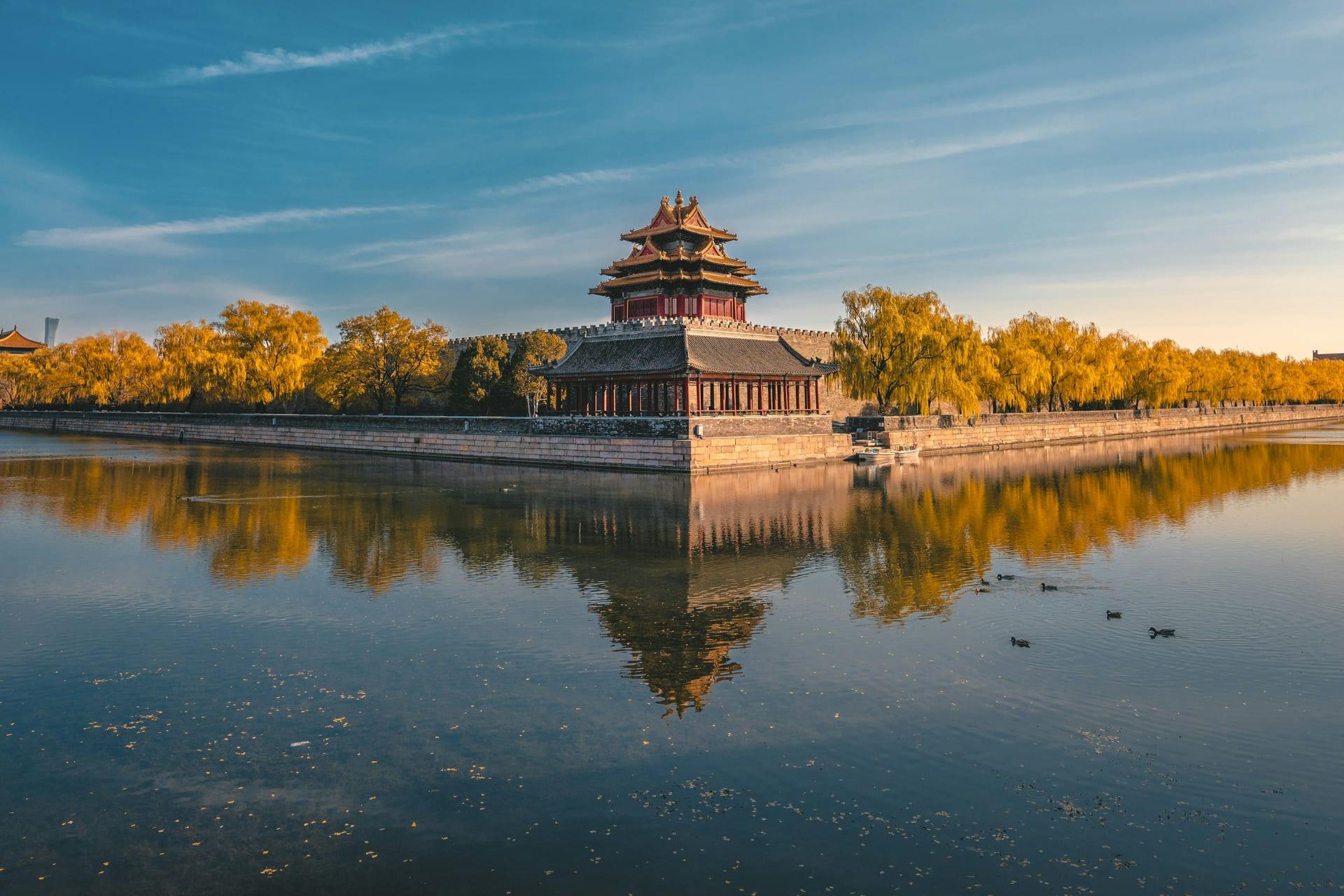
The Forbidden City told from outside, never entering the palace: the Northeast Corner Tower, the moat, the palace wall and the Gate of Divine Prowess from the moat's north bank, then Jingshan Park's Qiwang Tower, scholar tree, Guandi Temple, Shouhuang Hall and ridge pavilions up to the Wanchun Pavilion's view over the palace roofs.
Start · Northeast Corner Tower (东北角楼)
DirectionsStops
- 1
Northeast Corner Tower (东北角楼)
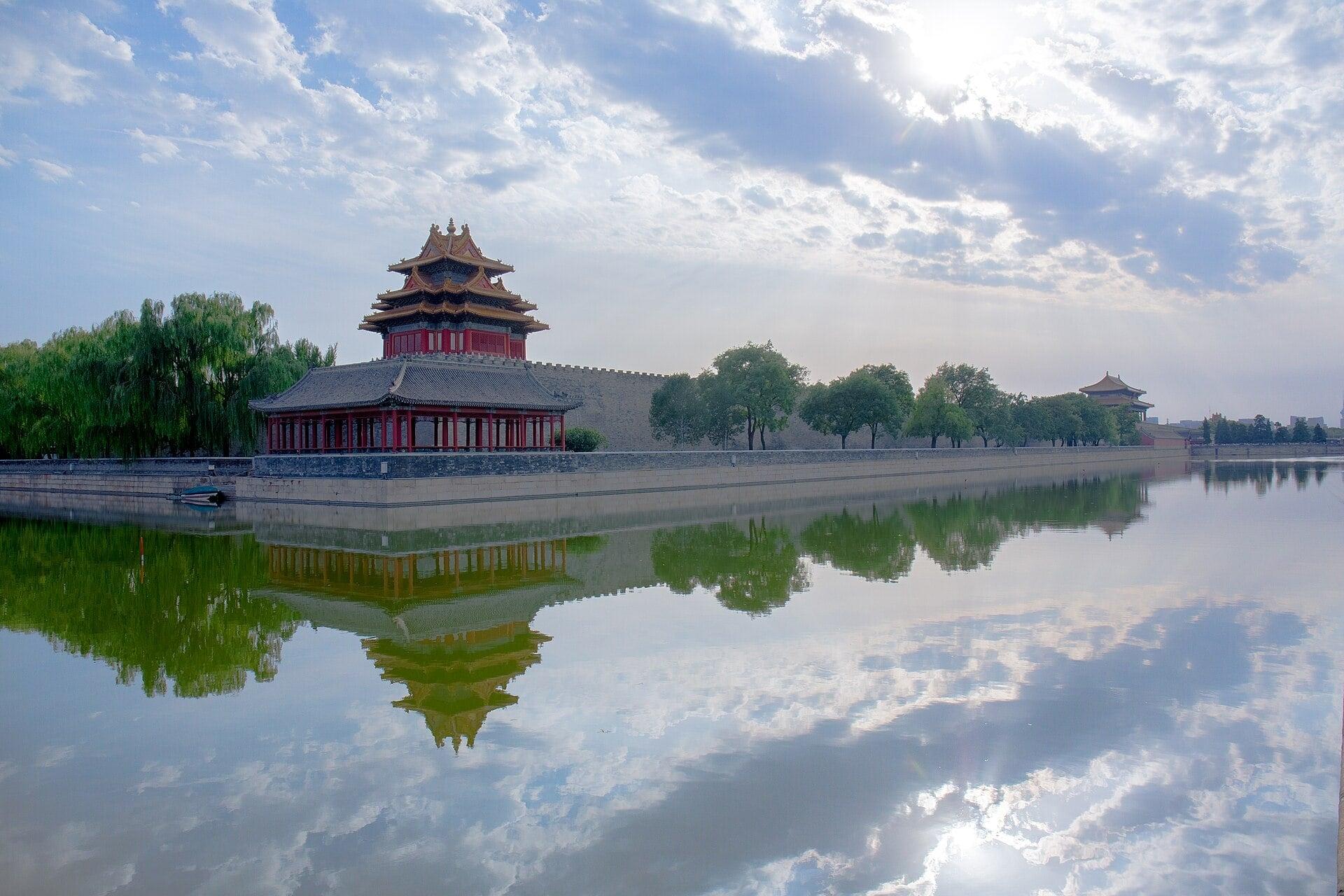
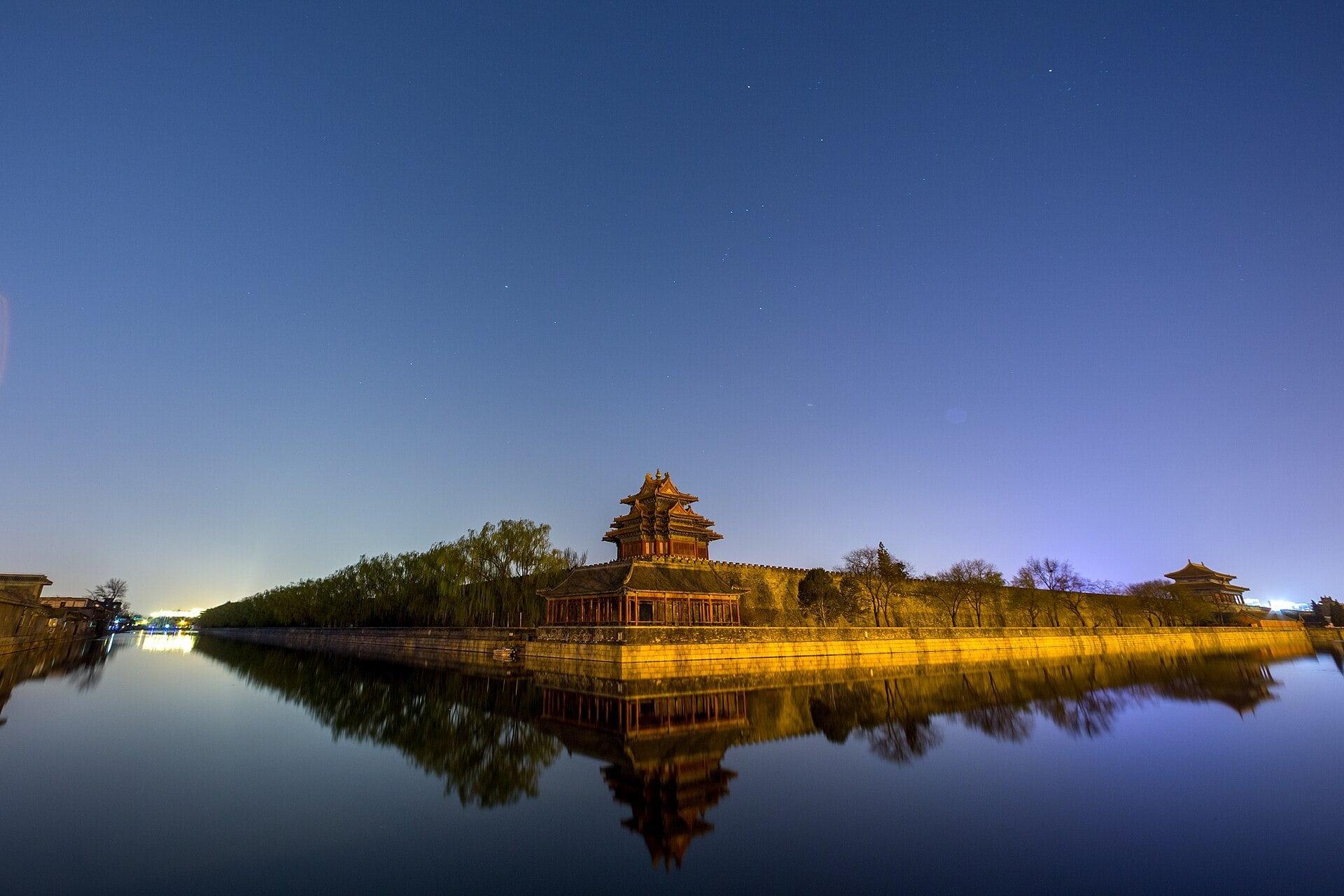
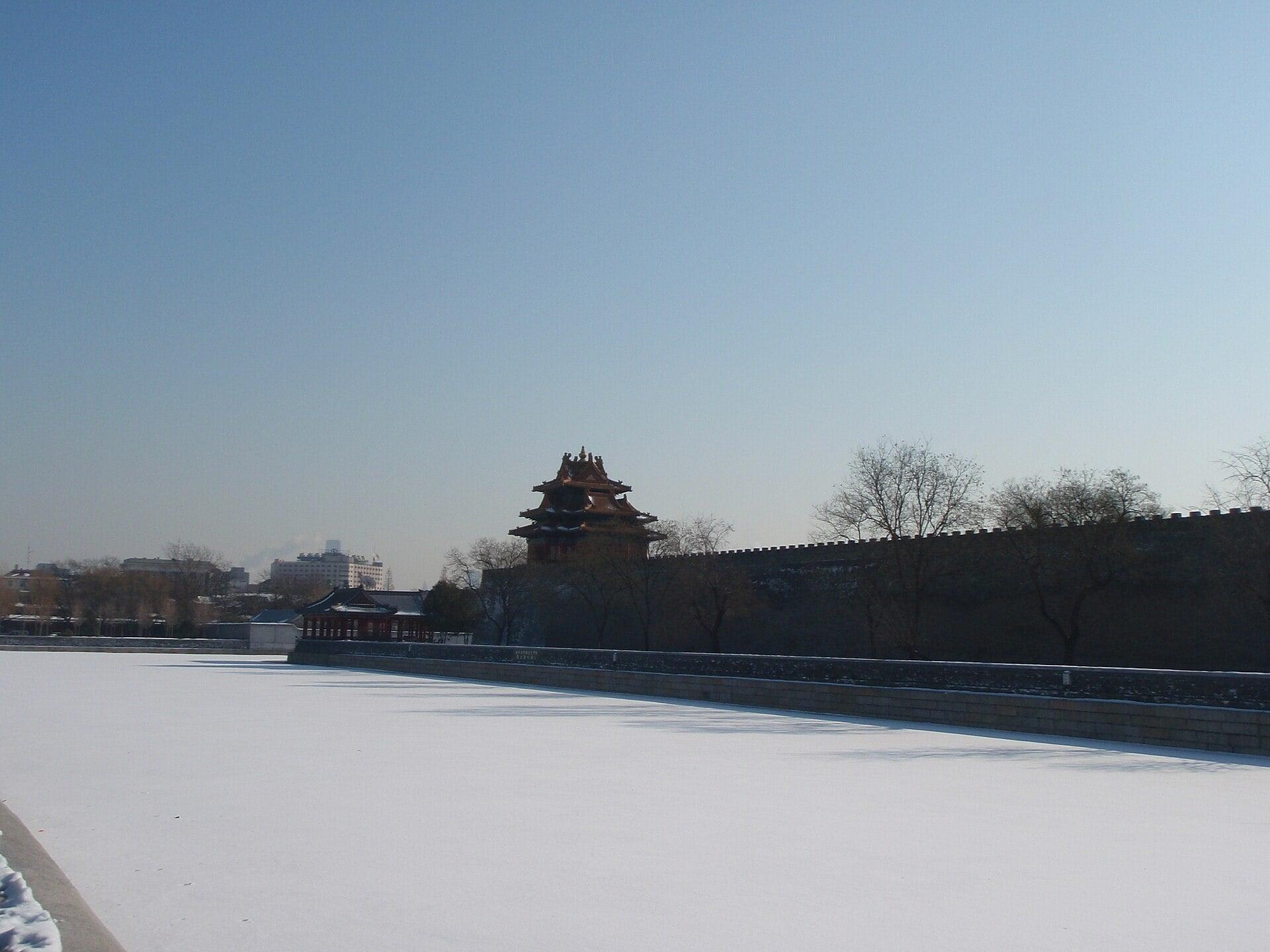
A watchtower made into a showpiece. The palace's Northeast Corner Tower, seen across the moat: a cross-shaped frame of 20 columns and 28 upturned eave corners behind the old legend of nine beams and eighteen pillars.
- 2
Palace Moat (筒子河)
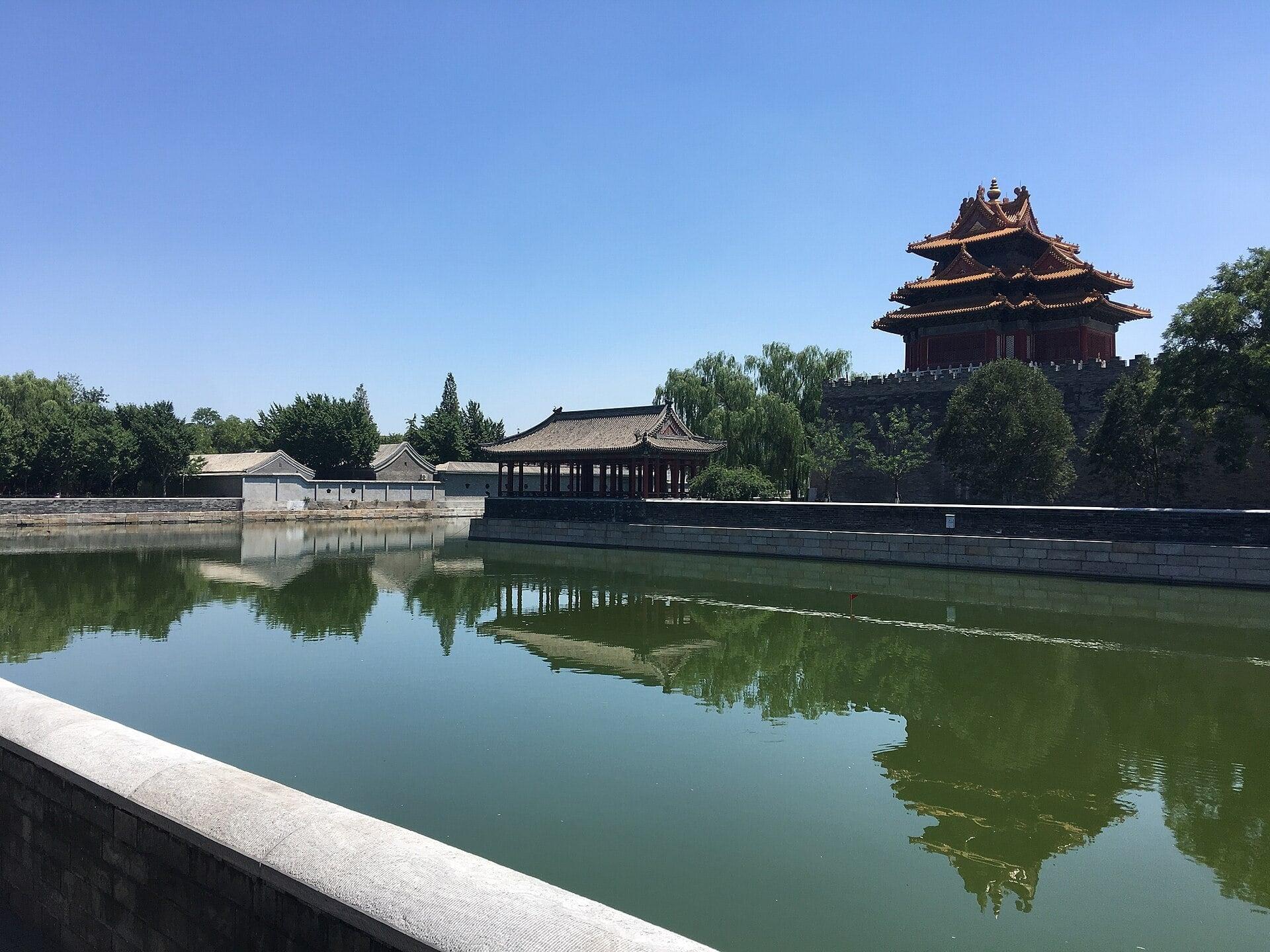
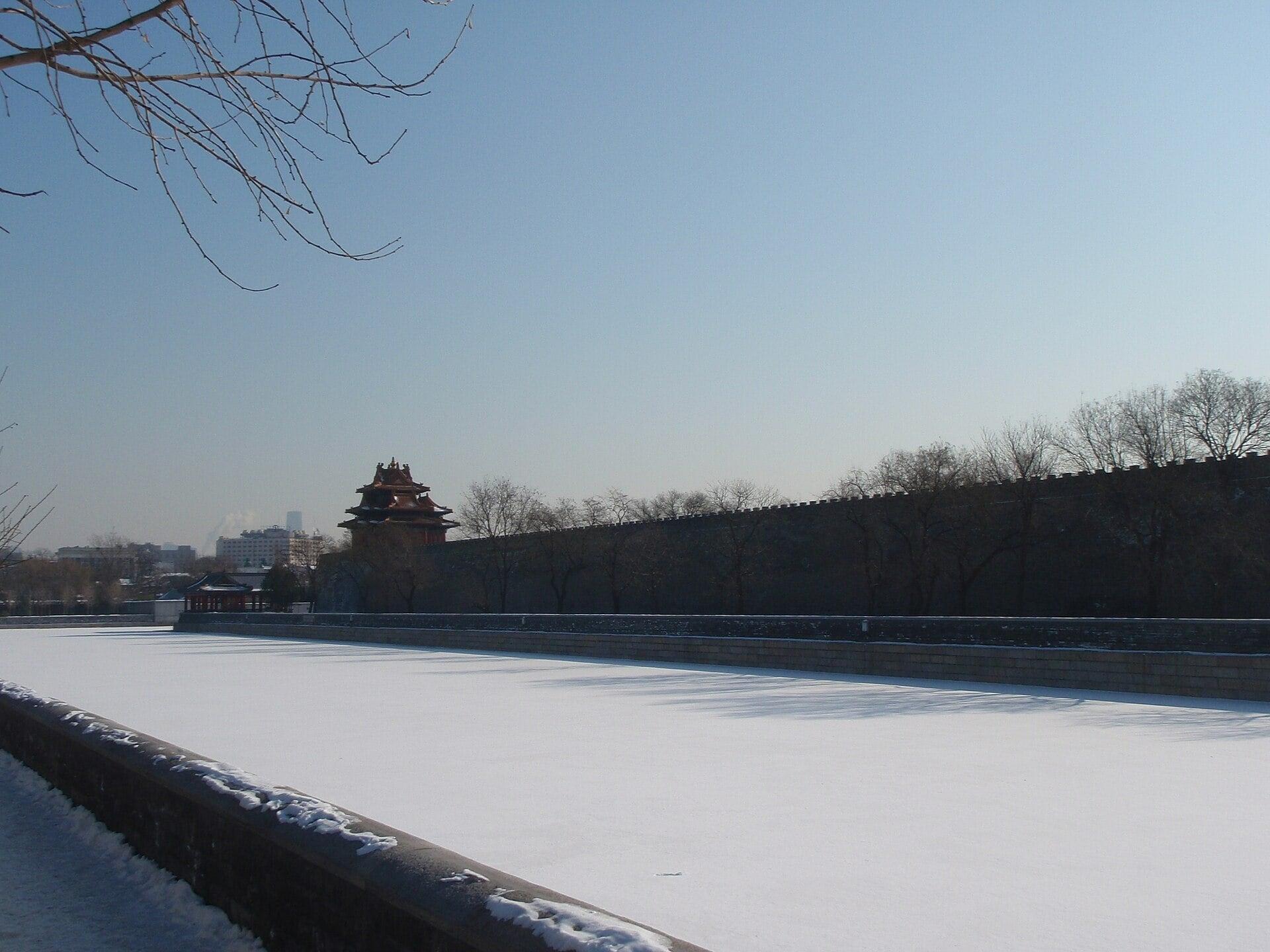
Fifty-two meters of stone-lined water. The moat runs 3.3 km around the palace, and the earth dug for it went largely into the hill across the avenue: wall, water and hill as one earthwork.
- 3
Palace Wall (紫禁城城墙)
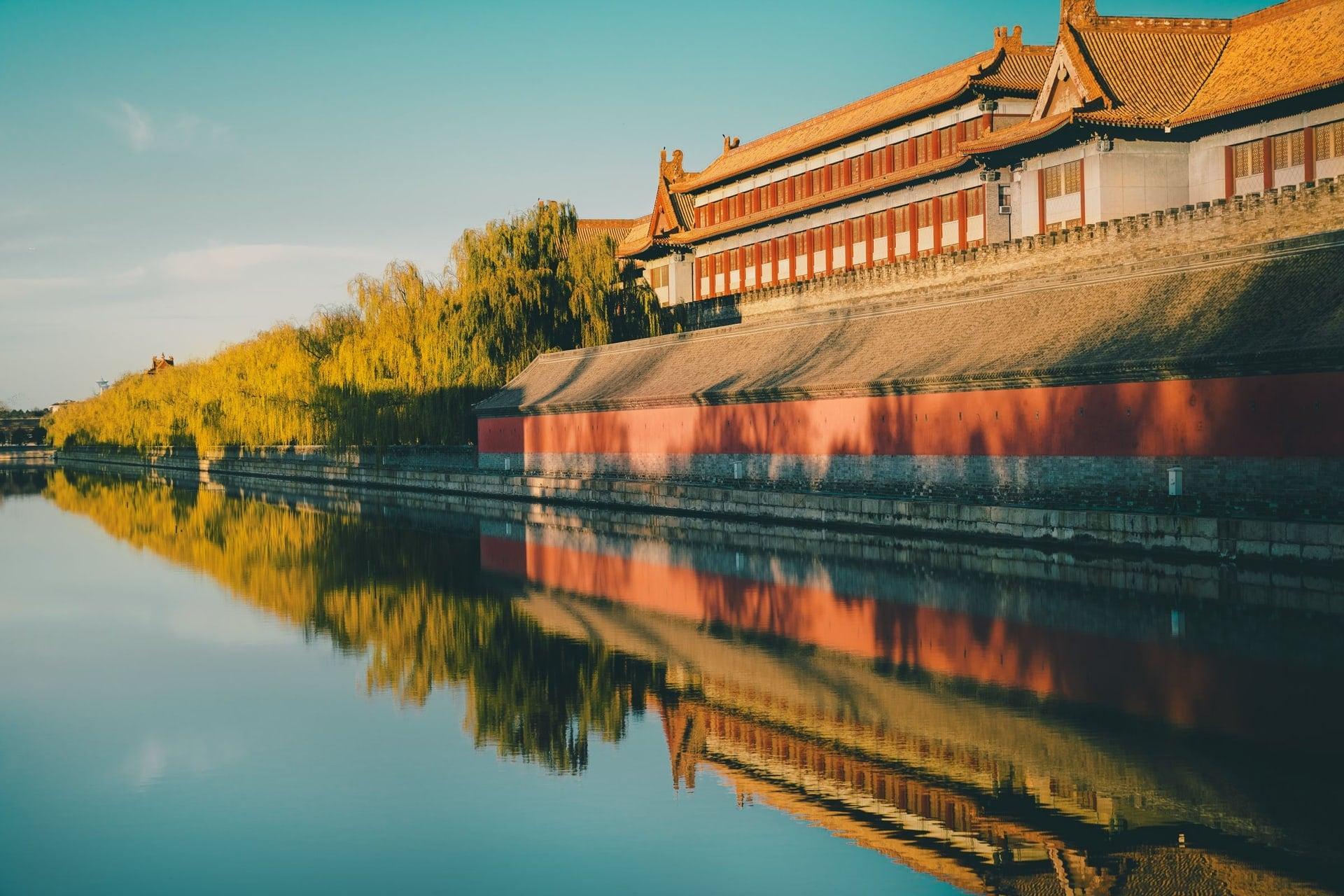
The palace's north side in one view. Dark red wall under yellow tiles, from the corner tower to the north gate, closing in a palace of about 720,000 square meters.
- 4
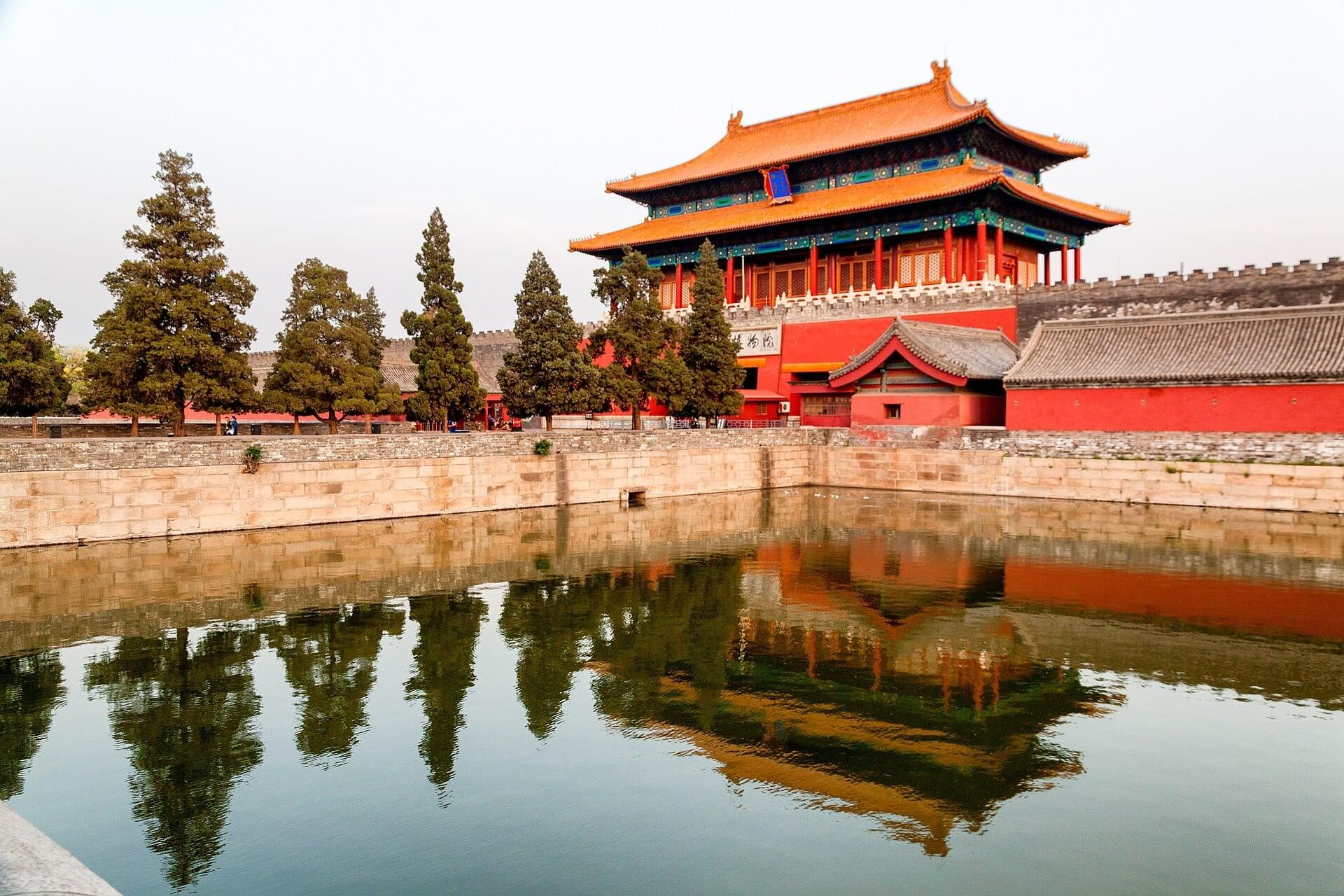
Gate of Divine Prowess (神武门)
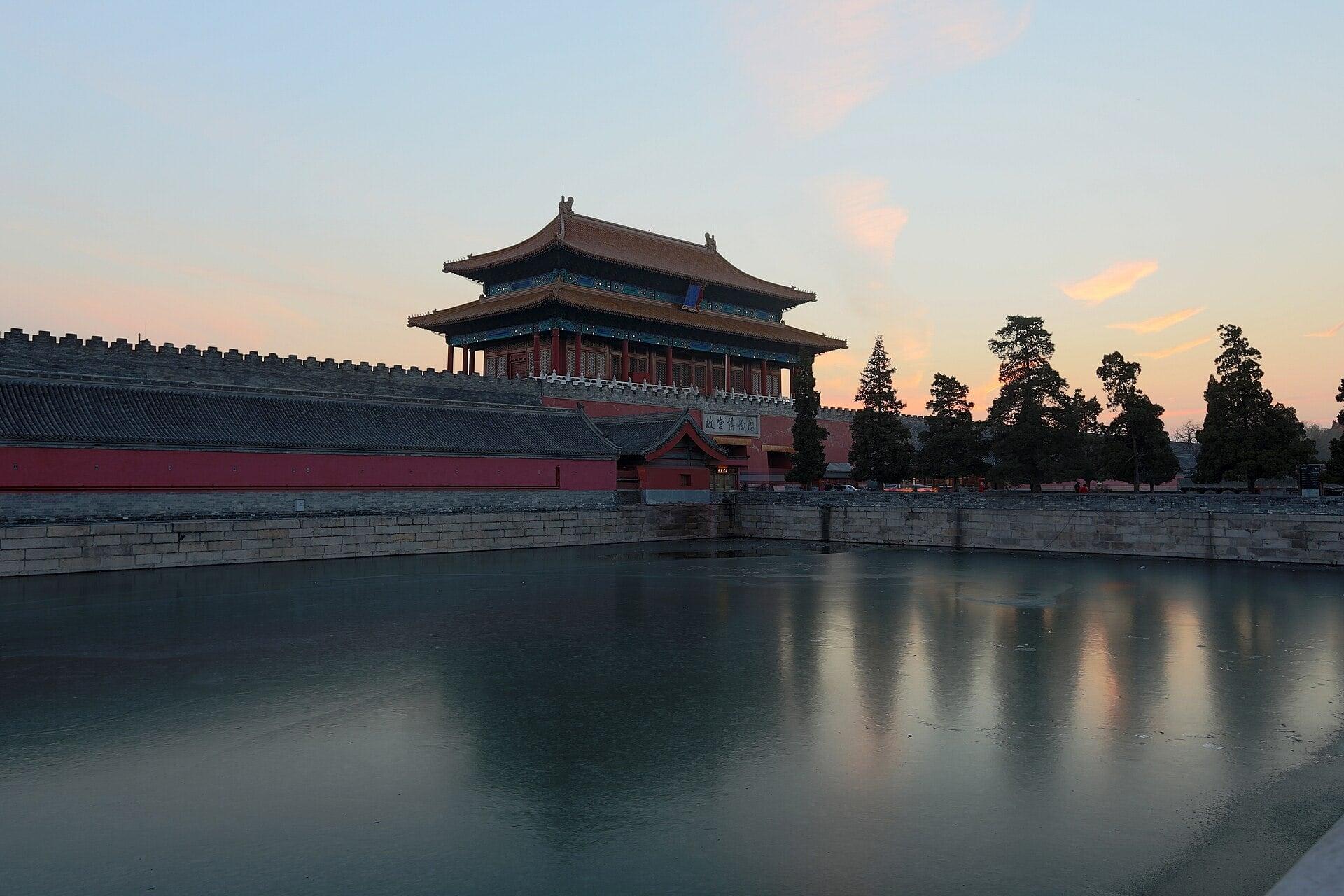
A back door named for a tortoise. Built in 1420 as the Black Tortoise Gate and renamed under the Qing for a taboo on an emperor's name, it stands on the city's axis.
- 5
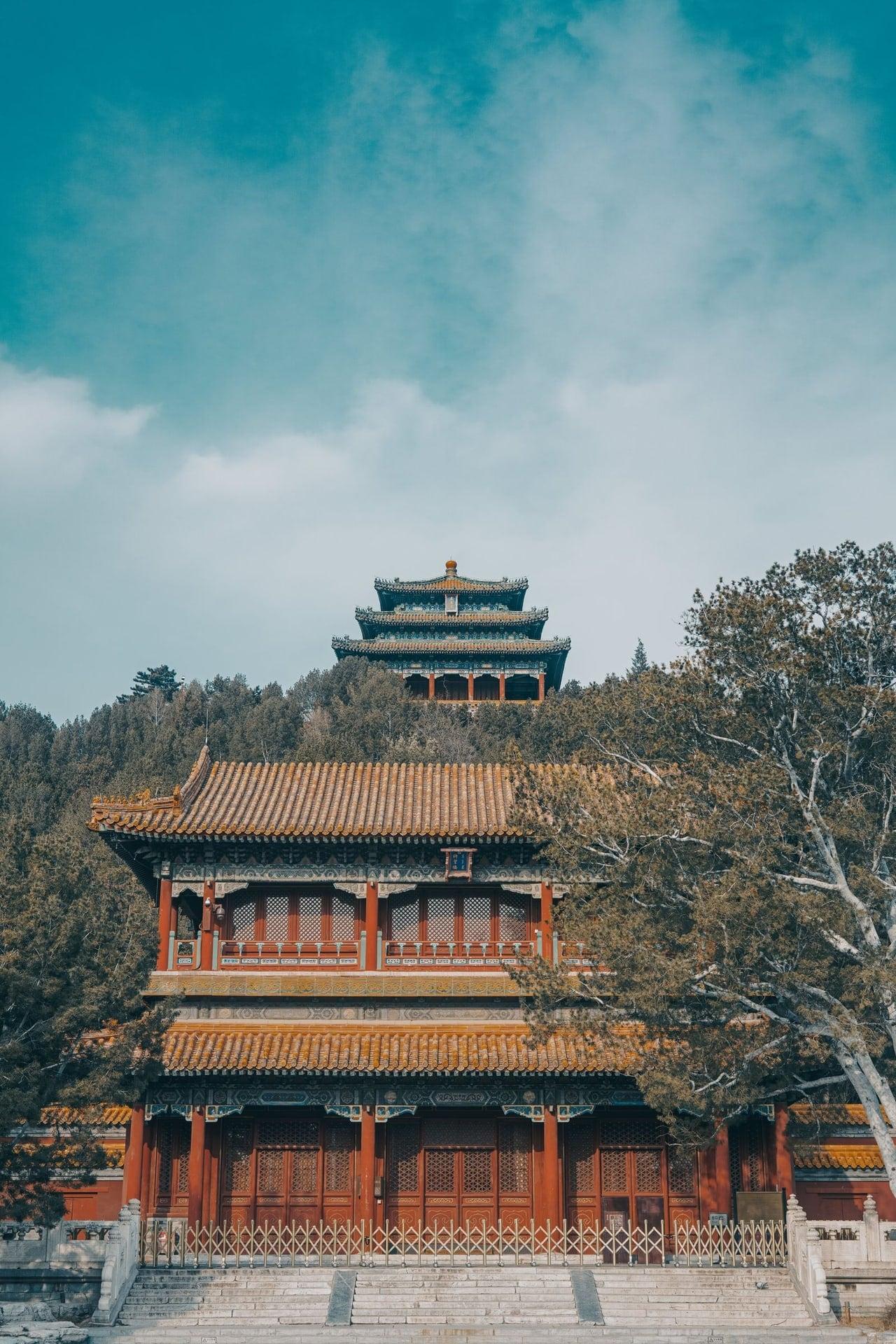
Qiwang Tower (绮望楼)
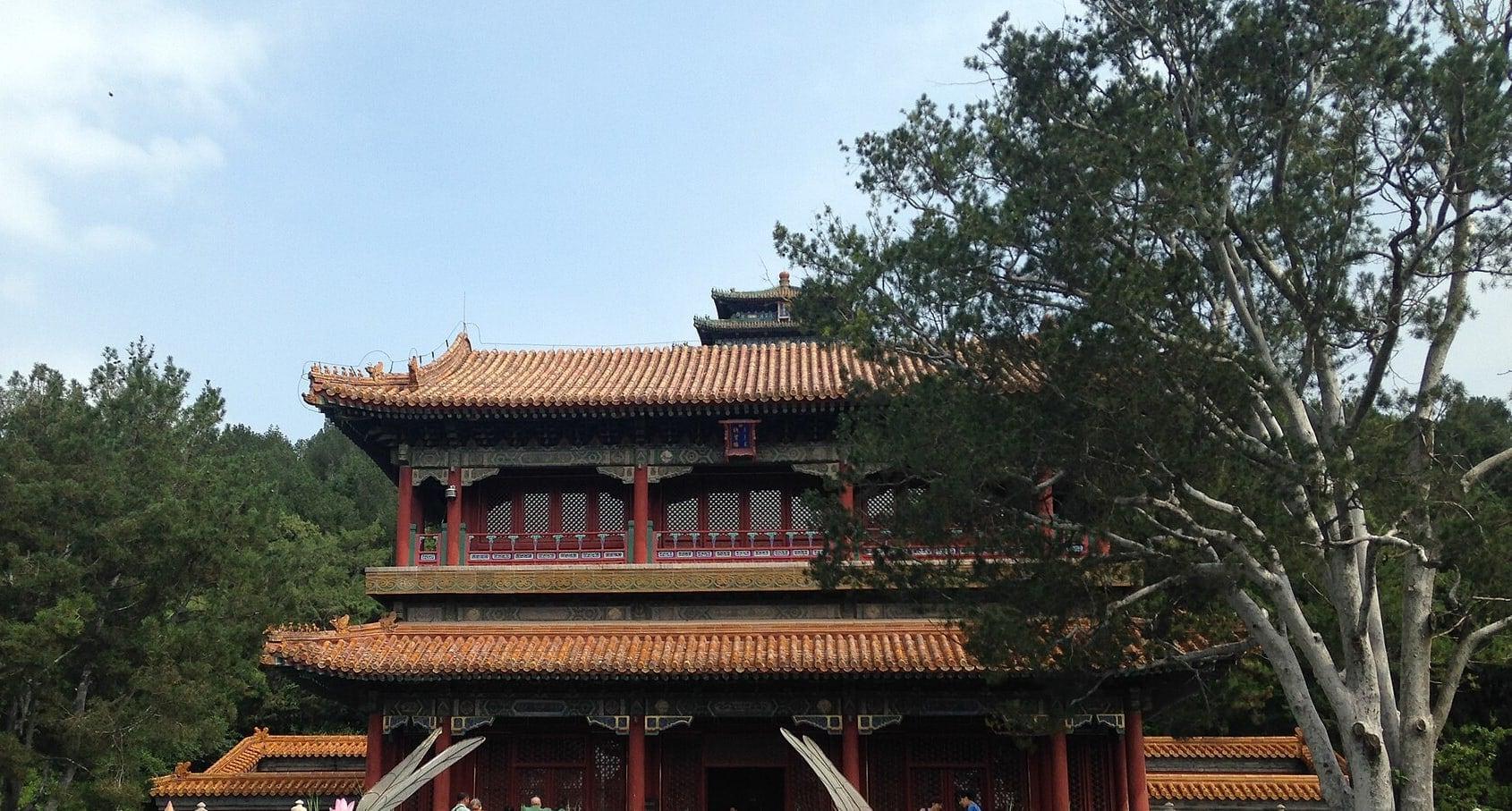
A school shrine at the hill's door. Inside Jingshan Park's south gate, Qiwang Tower was where Qing students honored Confucius; its broad terrace was a stage for a 64-person ritual dance.
- 6
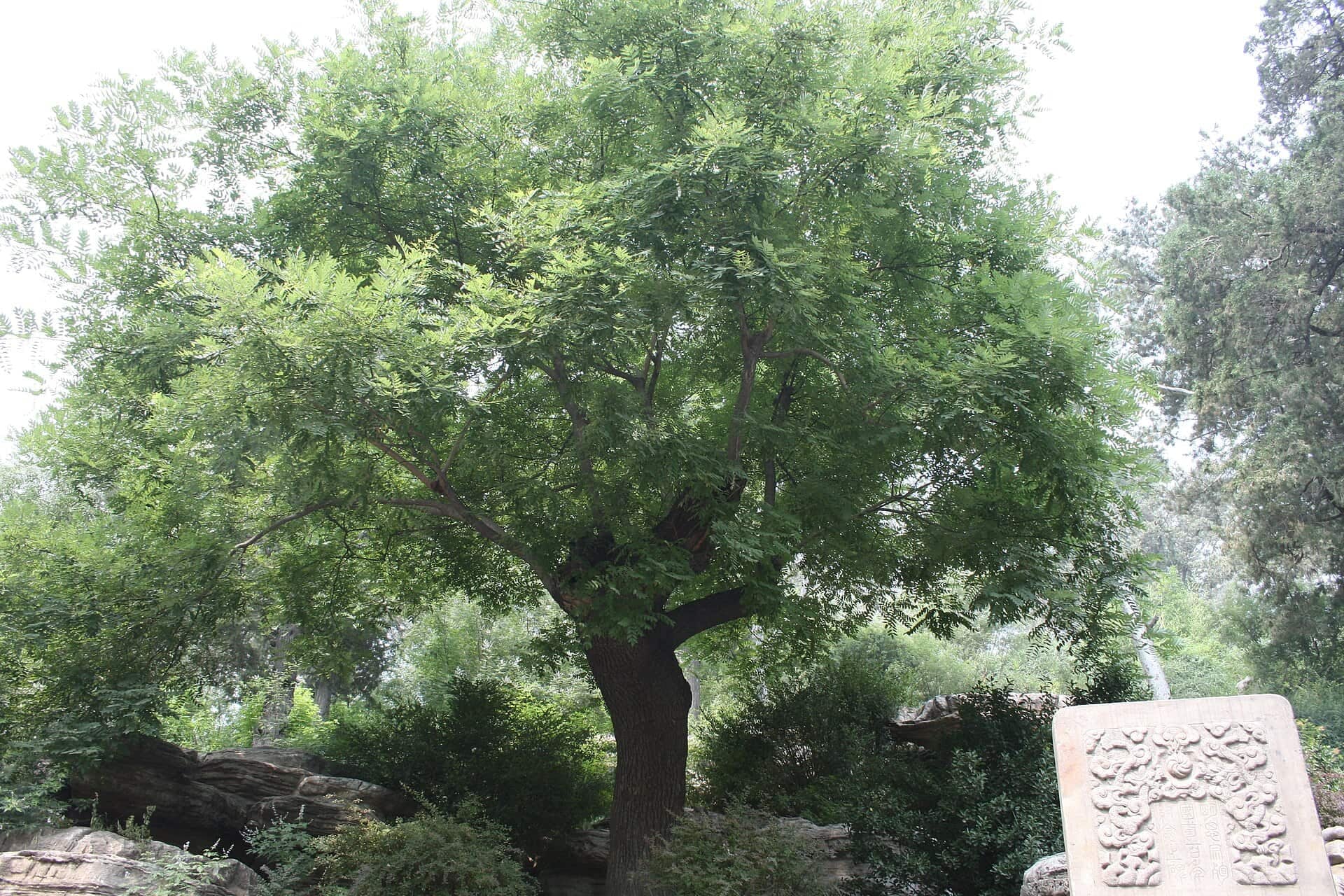
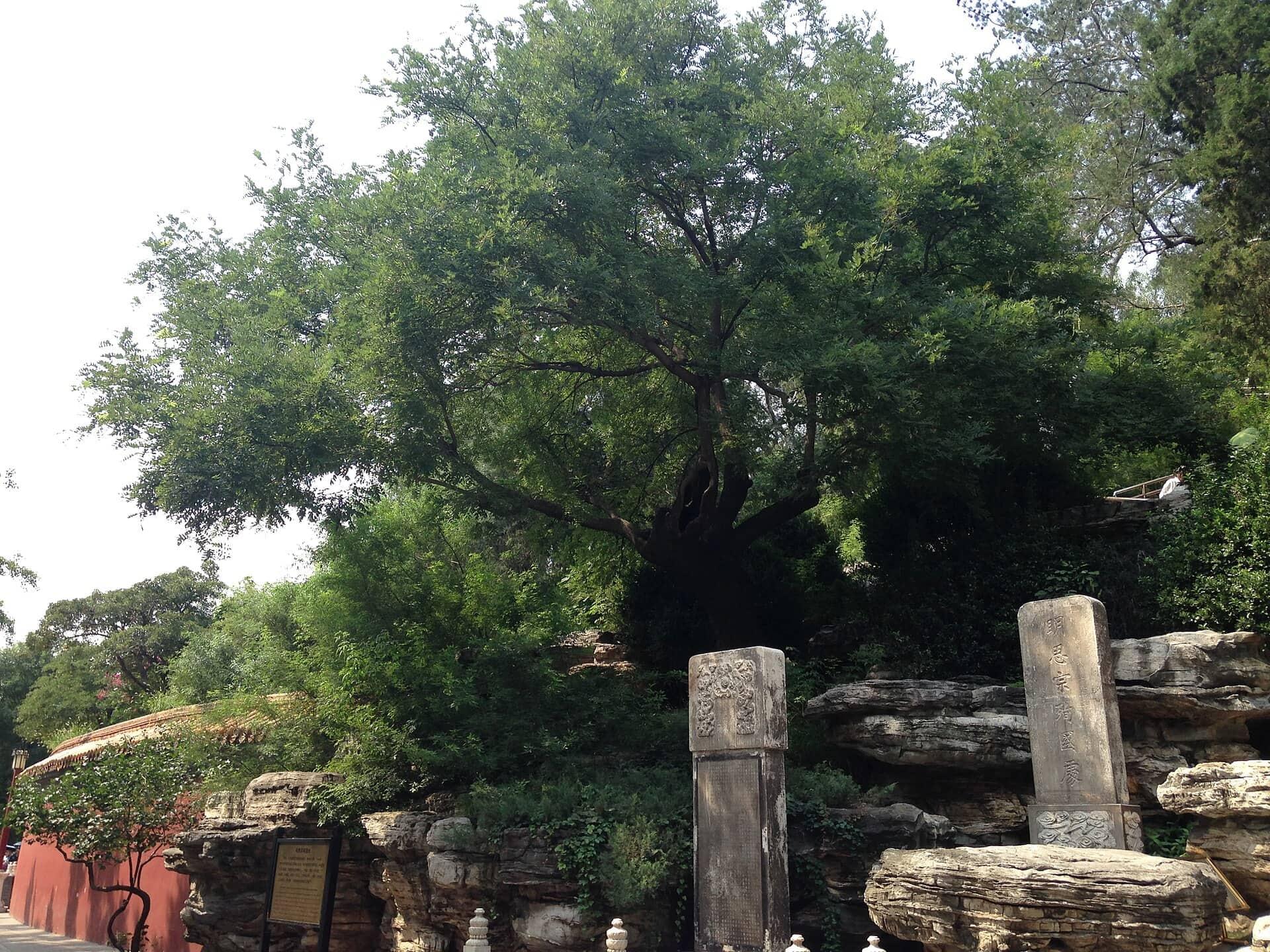
Scholar Tree (槐树)
A tree, two tablets and a date. Tradition places the last Ming emperor's death on 25 April 1644 at a scholar tree here; the tree you see was planted in 1996, beside a tablet of 1930.
- 7
Guandi Temple (关帝庙)
How a hill became a mourning ground. In 1748 Qianlong moved an archery hall and this temple of Guandi to give his empress a hall to lie in state, and later Qing emperors lay in state there too.
- 8
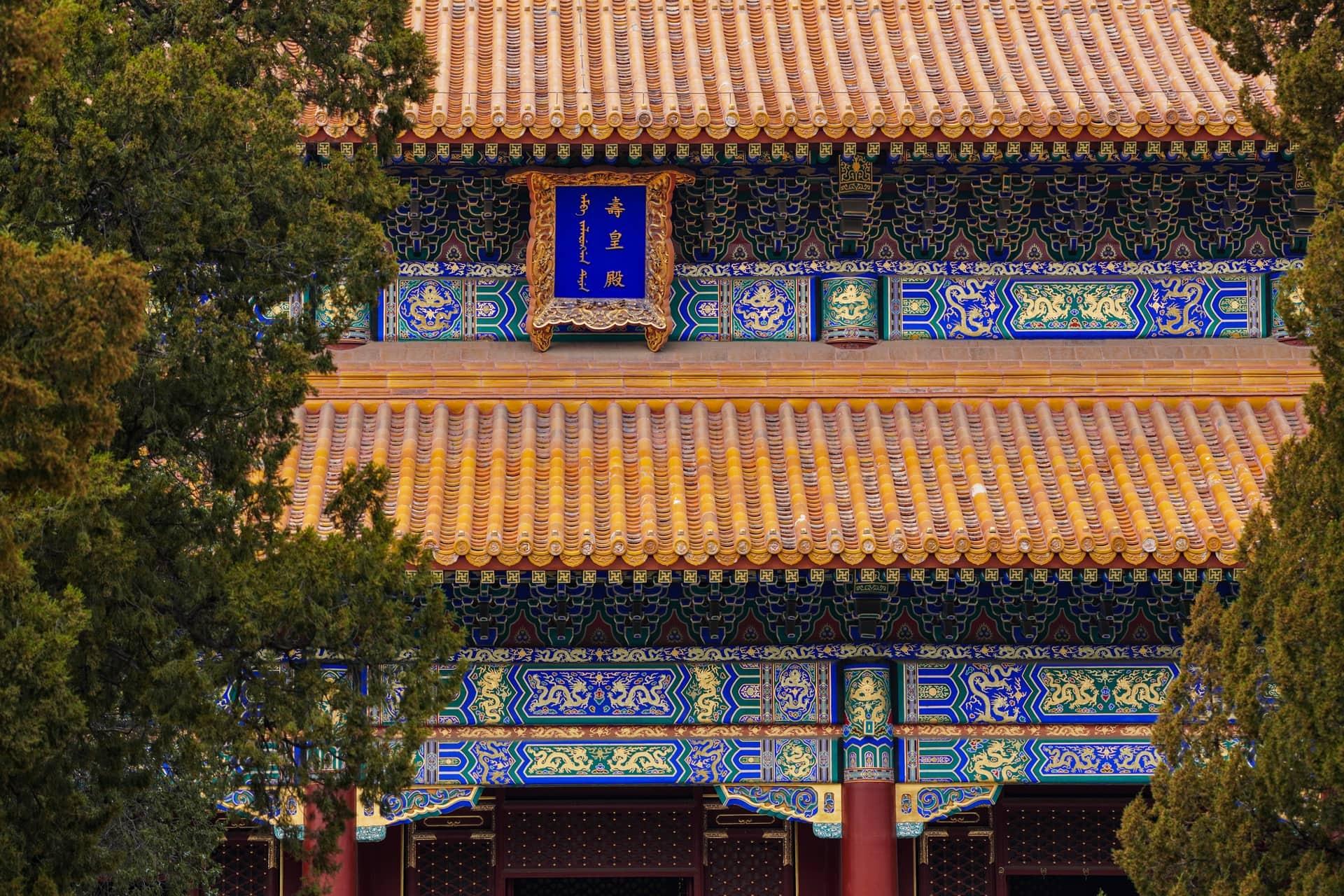
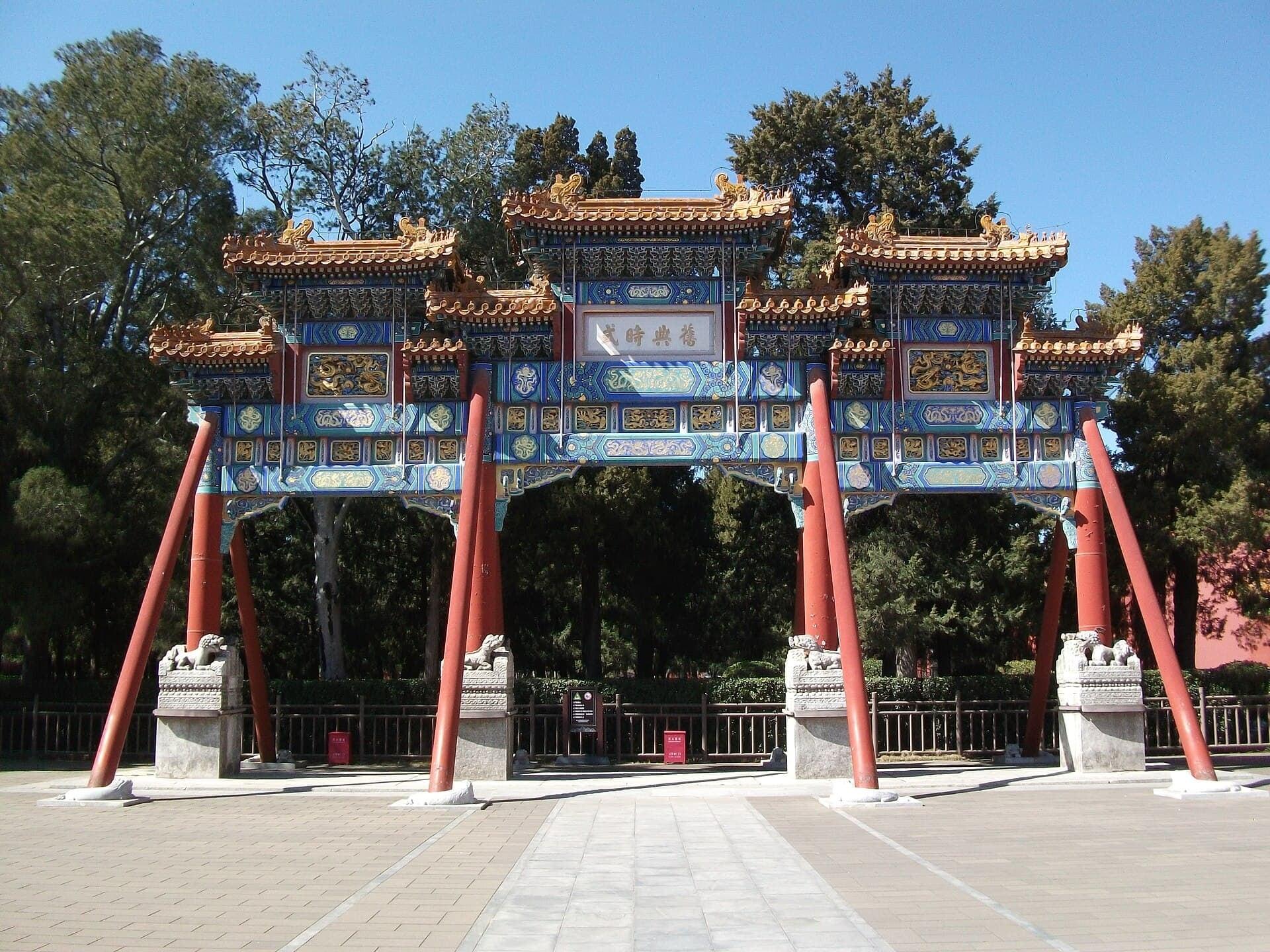
Shouhuang Hall (寿皇殿)
The ancestors moved onto the axis. Qianlong rebuilt this Ming hall in 1750 exactly on the city's center line, modeled on the imperial ancestral temple, behind three arches of the highest rank.
- 9
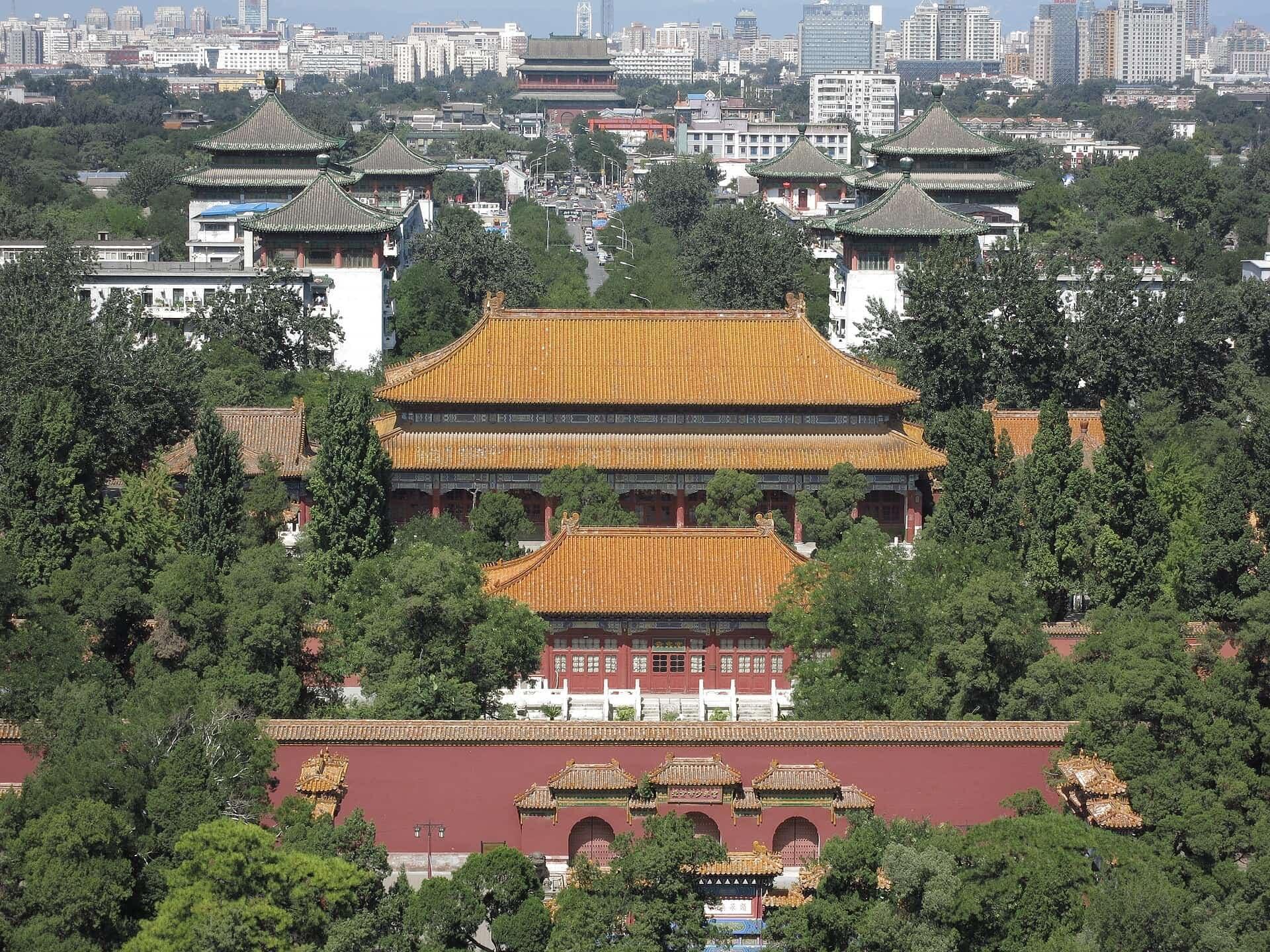
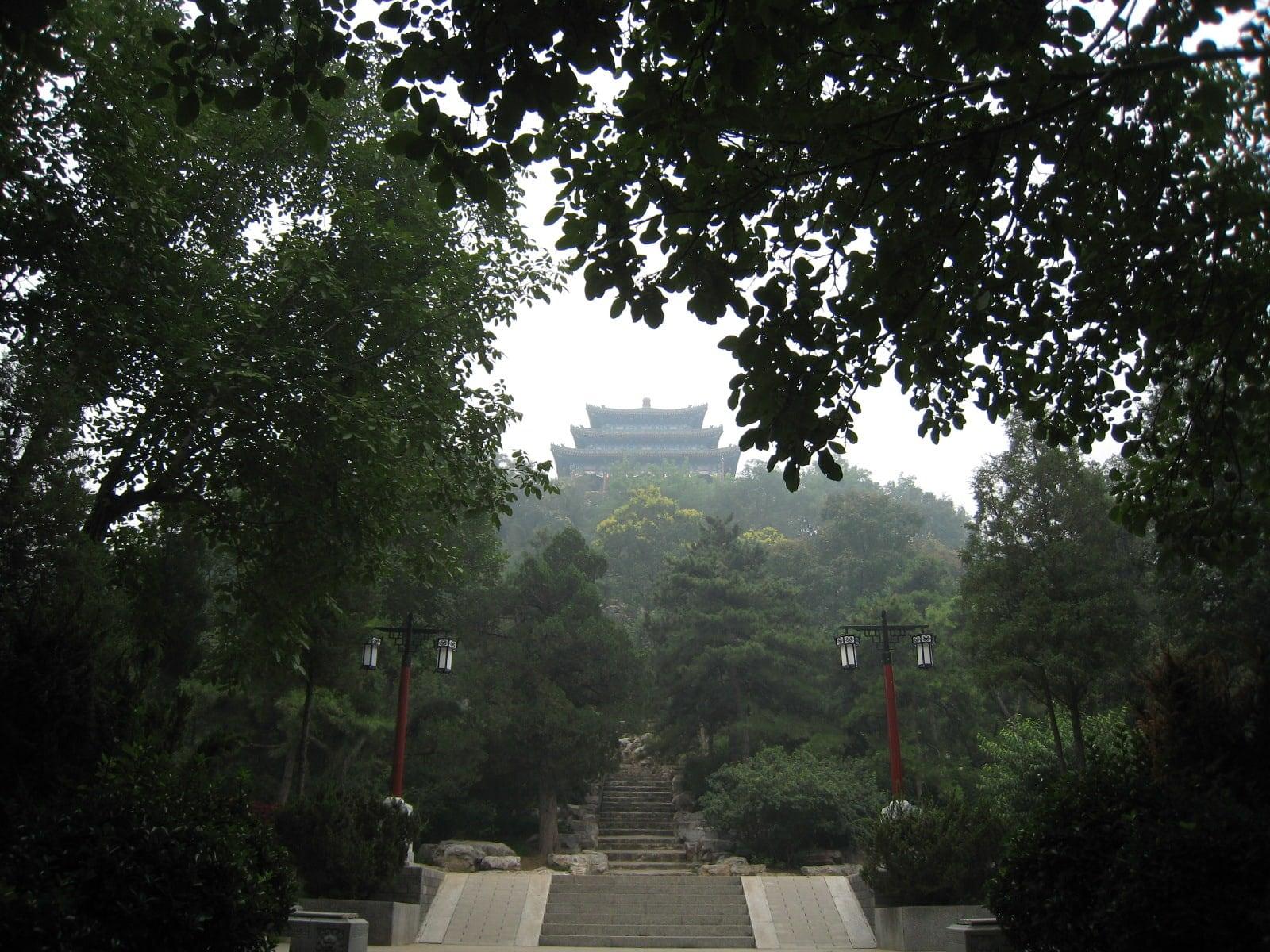
Jingshan North Slope (景山北坡)
Why a palace needs a hill behind it. Heaped up in the early 1400s, largely from the moat's earth, Jingshan was the palace's back-rest in feng shui terms, and has worn five names since.
- 10
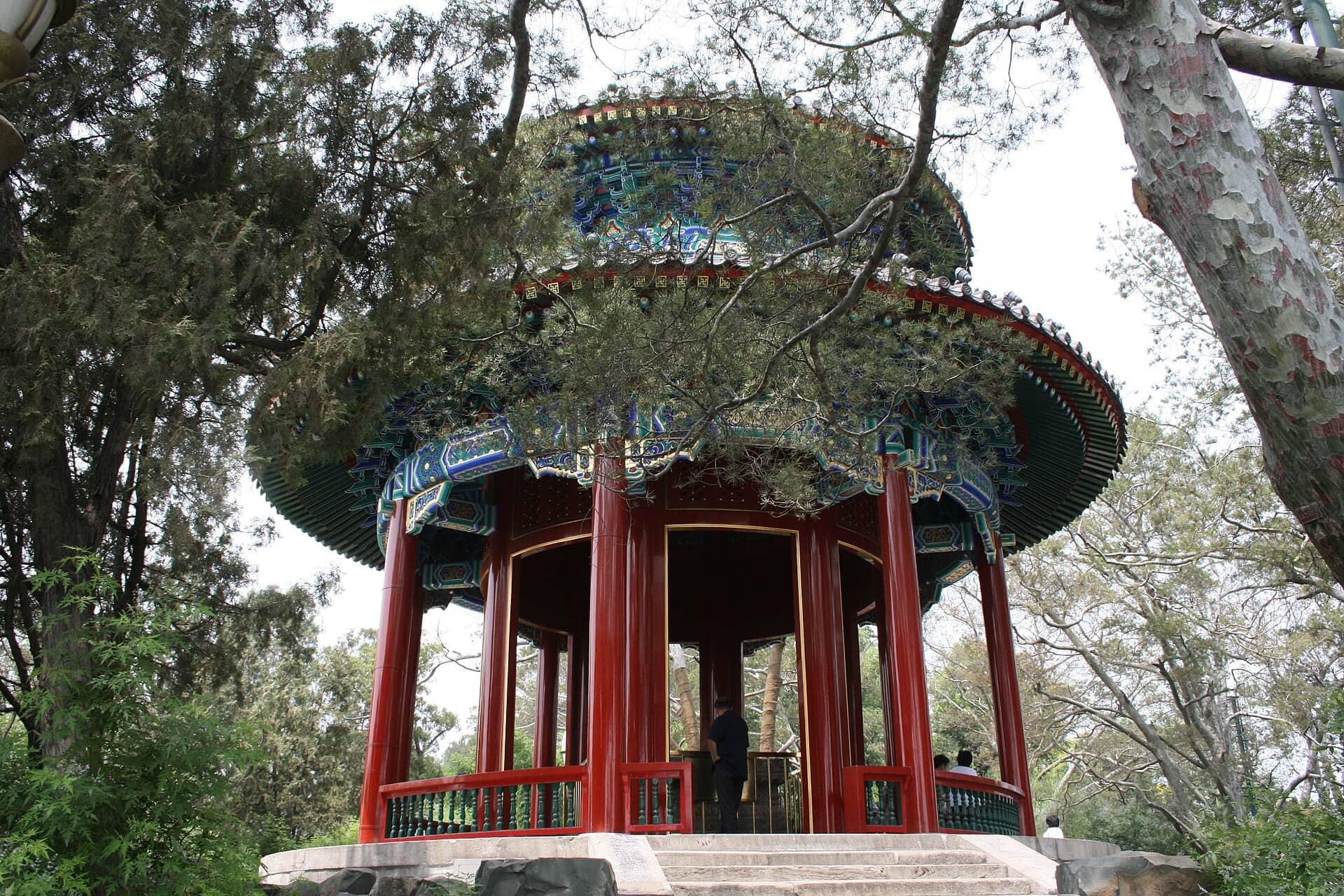
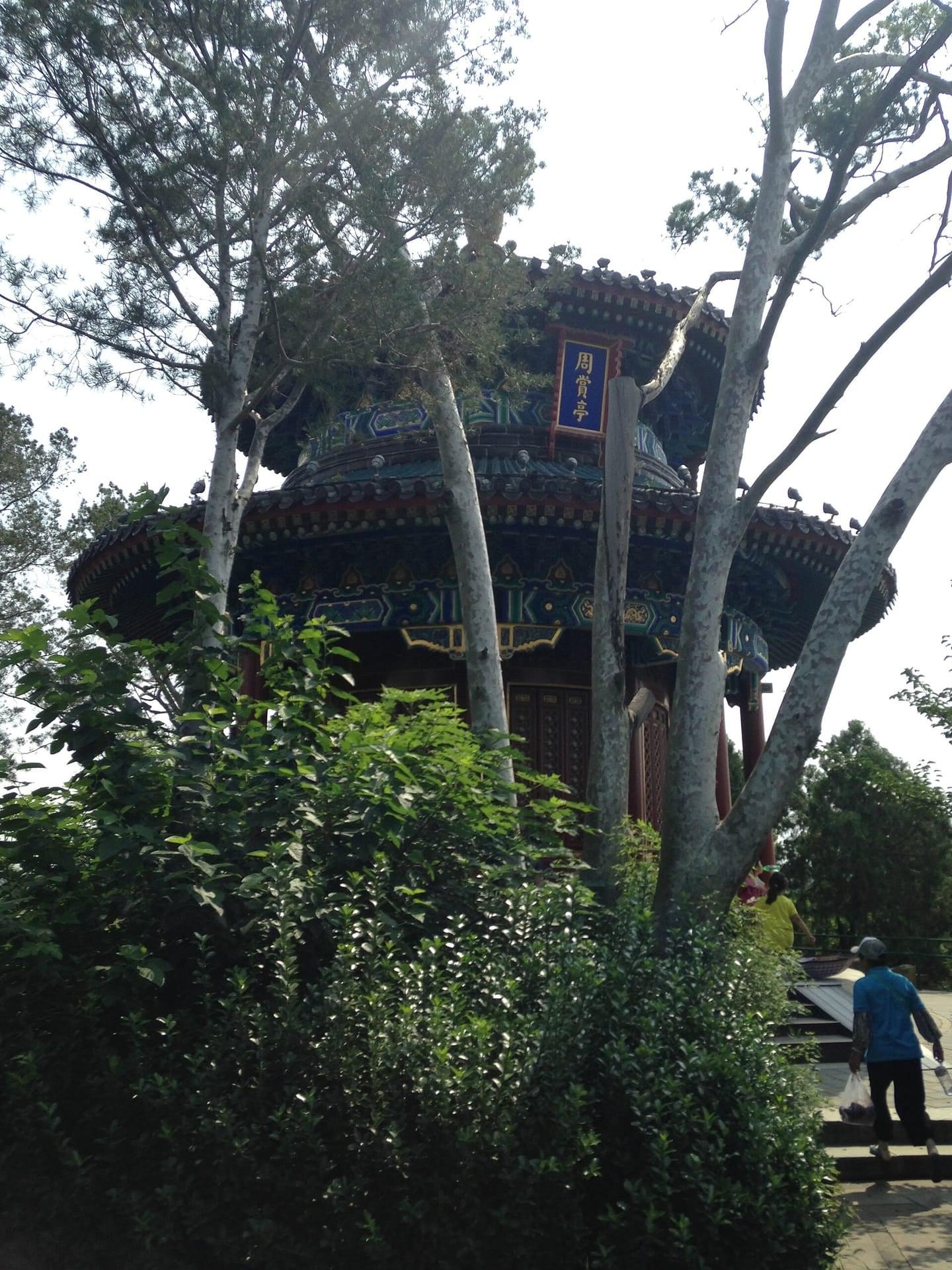
Zhoushang Pavilion (周赏亭)
Five pavilions on five peaks. Qianlong set a pavilion on each of the hill's peaks in 1750; this round, peacock-blue one is the first on the ridge, with the palace roofs appearing to the south.
- 11
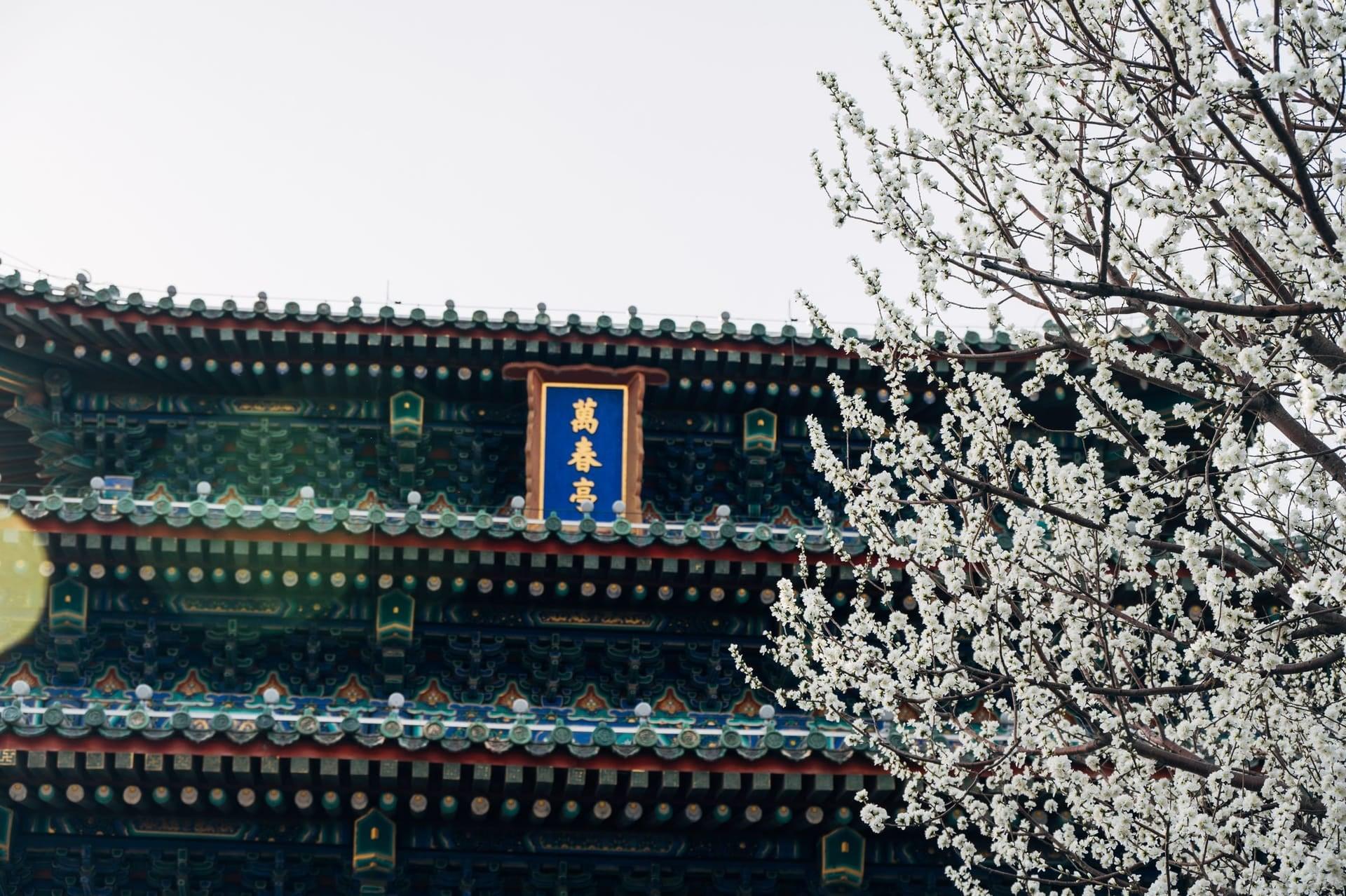
Wanchun Pavilion (万春亭)
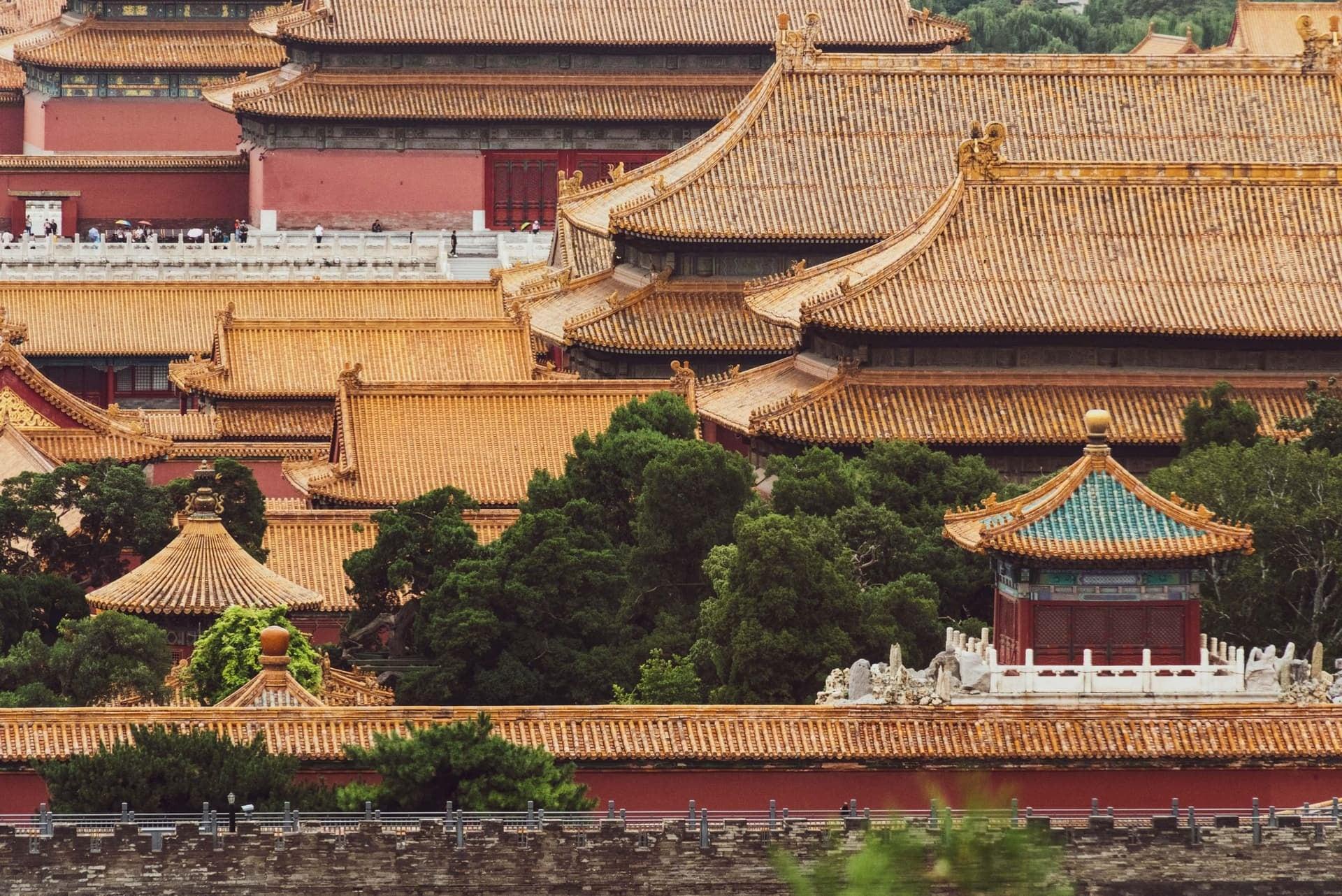
The whole design from the top. From the highest point of Beijing's central axis, the palace's yellow roofs fill the view south, and the axis runs on north toward the Drum Tower.
Details
Best Time to Visit
Any day; about 75 minutes. Mid-afternoon is best in winter: the park stays open until 20:00 (last entry 19:30) from 1 November to 31 March, so start by about 18:00 at the latest, and earlier if you want the view in daylight (sunset about 16:50 in December, 17:12 in mid-January). From about 15:30 to 16:30, every day except Mondays, palace visitors pour out of the Gate of Divine Prowess onto the bridge foot at stop 4; the summit is crowded at sunset. December averages about 3 °C (38 °F) by day and about minus 7 °C (20 °F) at night, with little rain; spring brings wind and dust. Avoid holiday afternoons on the summit: New Year 1 to 3 January 2027, the Spring Festival 5 to 13 February 2027 (Chinese New Year's Day is 6 February) and National Day 1 to 7 October. The city center can close streets or sites at short notice for major events: check the day before. Checked 25 November 2026.
Pro Tips
- •Getting to the start: subway line 8 to National Art Museum station. Leave by exit A (north-west), on the north side of Wusi Avenue, and walk west along that side for about 700 m to the traffic lights at Jingshan East Street. Cross the avenue on the zebra to the moat side and walk east along the moat about 150 m to the corner, about 15 minutes in all. You pass stop 2 on the way: it waits and plays after stop 1. Buses 109 and 191 also stop at Shenwumen, by stop 4. Metro stations have security checks: allow time. Checked 25 November 2026.
- •The palace itself is not part of this walk. To go inside on another visit: tickets are sold only in advance, by real name, on the Palace Museum's English site (intl.dpm.org.cn) with your passport, from 20:00 seven days before; no same-day tickets. 40 yuan from November to March, 60 yuan from April to October; closed Mondays except public holidays; winter last entry 15:30. Bring the original passport. Checked 25 November 2026.
- •Jingshan Park (stops 5 to 11) costs 2 yuan (10 yuan during exhibition periods). No booking is needed: buy at the south gate by cash, WeChat Pay, Alipay or a foreign Visa or Mastercard, and carry your passport. Checked 25 November 2026.
- •If the underpass at stop 4 is shut, walk on east along the moat about 230 m to the lights at Jingshan East Street, cross, and walk back west along the park side of the avenue to the south gate: about 500 m instead of 170 m.
- •If you skip the park, stops 1 to 4 make a short walk on their own; there is no free stand-in nearby for the summit view.
- •The walk ends on the summit. Jingshan's east gate, on Jingshan East Street, is about 480 m and ten minutes back along the ridge and down the east steps. National Art Museum station (line 8) is about 15 minutes from there: south down Jingshan East Street, then east along the north side of the avenue.
Safety & Precautions
- •Mainland China drives on the right. At the crossing on the way to the start (the Jingshan East Street lights), traffic on the near half of the avenue comes from your left and on the far half from your right, and cars turning right out of Jingshan East Street cross the zebra while you have the green: look before you step off.
- •Silent electric scooters ride the bike track between the moat sidewalk and the traffic, from both directions. Look as well as listen.
- •Keep to the sidewalk along the moat, back from its stone edge, especially at dusk, when photographers crowd the bank, and in icy weather. Never go onto the ice.
- •Steps: two flights at the underpass (stop 4 to 5) and several flights up the hill, with no step-free way to the summit. The steps can be slippery with frost or ice.
- •The bridge foot at stop 4 fills with palace visitors leaving from about 15:30 to 16:30 except on Mondays, and the summit terrace is crowded at sunset and on holiday afternoons: keep bags closed.
- •Carry your passport. Do not photograph security staff or checkpoints. The city center can close streets or sites at short notice for major events: check the day before.
Gallery
Read the walk
The full story of Forbidden City Outside: Moat, Corner Tower and Jingshan Hill, in words. Prefer to listen? Play it narrated, from home or on location.
Introduction
The Forbidden City sits inside a wall, the wall inside a moat, and behind the moat rises a hill made largely from the moat's earth. This walk tells the palace from outside, in the heart of old Beijing: along the moat's north bank to the palace's north gate, then up Jingshan, the hill behind it, for the view over its golden roofs. The palace, its moat and the hill were made as one design.
The walk does not go inside the palace. Going in needs a ticket booked in advance with your passport on the Palace Museum's English website, and it is not included. This walk is built to be worth it without going in.
There are eleven stops over about one point eight kilometers, just over a mile, and it takes about seventy five minutes. The moat bank is flat; the hill is a climb of over forty meters on steps, with no step free way up. The first four stops are free. Jingshan Park costs two yuan at the gate; carry your passport. In winter its last entry is at seven thirty in the evening.
In mainland China traffic keeps to the right, so at a crossing without lights look left first. The walk itself crosses no road at street level: it goes under the avenue by an underpass with steps. Silent electric scooters ride the bike track beside the moat, from both directions.
December to February is dry and cold, often below freezing, so dress for it. Have mobile data that works in mainland China, and download this tour before you set out.
To reach the start, take subway line eight to National Art Museum, leave by exit A, walk west along the avenue's north side to the lights at Jingshan East Street, cross to the moat and walk east to the corner.
When you arrive at the Northeast Corner Tower, begin with stop one.
1. Northeast Corner Tower (东北角楼)
Across the water, on the corner where the palace wall turns, stands the Northeast Corner Tower: a small square tower carrying three tiers of golden yellow roofs, their eaves flicking up at every corner. This walk stays outside the Forbidden City, and from this bank you see the tower whole, ticket or not. Going inside needs a ticket booked in advance with your passport, and it is not part of this walk. The walk is built to be worth it without going in.
There are four towers like this, one on each corner of the wall, part of the palace finished in fourteen twenty under the Yongle emperor, the Ming ruler who built the palace, its moat and the hill behind you. Their job was to watch over and defend the palace. They became something else: a showpiece of Chinese carpentry.
The craftsmen's legend says each tower had to have nine beams, eighteen pillars and seventy two ridges, and that the design came from a cricket cage. It is a legend. When the north west tower, built like this one, was surveyed during a repair, its frame turned out to be far more complicated. At its heart is a square pavilion about eight point eight meters on a side, with a wing on each of its four faces, so the plan is a cross, fourteen point four meters each way. There are twenty columns, not eighteen. The roofs have twenty eight projecting eave corners and sixteen inward ones, and inside, six kinds of beam, four kinds of purlin, thirteen kinds of tie beam and eleven kinds of bracket set are all joined by mortise and tenon, wood locked into wood.
Photographers line this bank at dusk for the tower and its reflection.
The tower, the wall, the moat and the hill were planned together, and the walk reads them as one design.
Follow the route back west along the moat side sidewalk, with the water on your left. Next, the moat itself.
2. Palace Moat (筒子河)
Between this sidewalk and the palace wall lie fifty two meters of water. Beijing people call the moat Tongzi He, the tube river, and it runs right around the palace, about three point three kilometers in all. Its banks are built of dressed stone, its bed is paved with large stones, and it holds more than half a million cubic meters of water, fed by the city's old water system from the Jade Spring in the Western Hills.
A moat is a defense: water between the palace and anyone outside it. But digging one leaves you with a great deal of earth, and here the earth was put to use. Look ahead and to your right, across the avenue. The wooded hill with a pavilion on its crest is Jingshan. It was heaped up in the early fourteen hundreds largely from the earth dug for this moat, over an older mound.
So the ditch beside you and the hill across the avenue are two halves of the same piece of work. The palace sits inside the wall, the wall sits inside the water, and the spoil from the water became the hill that closes the palace at the back. You will climb that spoil at the end of the walk and look down on the moat from the top.
In hard winters the moat freezes. Keep to the sidewalk, back from the stone edge, especially at dusk and in icy weather.
Follow the route west along the moat, the water still on your left. Next, the palace wall.
3. Palace Wall (紫禁城城墙)
From here the palace's whole north side is in view across the water: the corner tower at one end, the gate tower at the other, and between them the wall, dark red under a coping of yellow glazed tiles. Those two colors are the palace's colors, and you will see them again from the top of the hill, roof after roof.
Behind this wall lies a palace covering about seven hundred and twenty thousand square meters. It is a closed rectangle at the center of the old city: walled on every side, watched from a tower at each corner, wrapped in water.
Why a wall, and a moat, and a hill? Defense first: a wall to keep people out and water to keep them back from the wall. Then display: from the avenue, this long red face and its golden towers told everyone what stood inside without letting anyone see it. And then order. The palace was set on the line that runs north and south through the middle of Beijing, and everything here, the gates, the halls, the hill across the avenue, was placed on that line or balanced either side of it.
The gate ahead stands on that line. So does the hill.
Follow the route on west to the bridge in front of the gate. Silent electric scooters use the bike track between the sidewalk and the traffic, from both directions: keep to the sidewalk. Next, the palace's north gate.
4. Gate of Divine Prowess (神武门)
Turn to face the water. Straight across, at the far end of the bridge, is the palace's north gate, the Gate of Divine Prowess, thirty one meters tall. It was built in fourteen twenty, the year the palace was finished.
Its first name was Xuanwu Gate, the gate of the Black Tortoise. In old China four creatures stood for the four directions: the Azure Dragon on the left, the White Tiger on the right, the Vermilion Bird in front and the Black Tortoise behind. The palace faces south, so its back door, here in the north, belonged to the tortoise. Under the Qing dynasty the gate was rebuilt and renamed. The first character of its old name was also part of the reigning emperor's personal name, and an emperor's personal name was not to be written. So the Black Tortoise Gate became the Gate of Divine Prowess.
It is still the palace's back door: this is where visitors leave. Late on winter afternoons, toward the four thirty closing, the bridge foot fills with people coming out. On most Mondays, when the palace is closed, it is quiet.
Now look the other way, across the avenue. The gate in the park wall opposite is Jingshan's south gate, and the pavilion on the hilltop above it stands on the same line as this gate: the north south line the city was laid out on. The rest of the walk climbs that line.
Follow the route down the steps into the underpass beside the bridge, and up the steps on the far side; do not cross the avenue at street level. The park's south gate is a few steps along: buy your ticket there. Next, the first stop inside Jingshan Park.
5. Qiwang Tower (绮望楼)
You are inside Jingshan Park. Straight ahead, at the foot of the hill, stands Qiwang Tower, and behind it the hill climbs to the pavilion on its crest, on the same line as the palace gate you have just left. A school shrine at the hill's door. Under the Qing dynasty, the…
Full narration for this stop unlocks with the tour.
6. Scholar Tree (槐树)
On your left, at the foot of the slope, a scholar tree stands with two stone tablets beside it. This hill was raised by the Ming dynasty. On the twenty fifth of April, sixteen forty four, as a rebel army entered the city, the last Ming emperor took his own life on this hill,…
Full narration for this stop unlocks with the tour.
7. Guandi Temple (关帝庙)
Face the red wall and gate directly ahead: this is the Guandi Temple. To its left, as you face it, is the walled court of Guande Hall. Guande Hall began, in the late Ming, as the place where the emperor and his officials held archery rites. Its name comes from the Book of…
Full narration for this stop unlocks with the tour.
8. Shouhuang Hall (寿皇殿)
Ahead of you is the gate of Shouhuang Hall, and around you, left, right and behind, stand three memorial arches, called pailou. Each has four posts and nine roofs, the highest rank an arch could be given. Behind the gate is the hall where the Qing imperial family made offerings…
Full narration for this stop unlocks with the tour.
9. Jingshan North Slope (景山北坡)
In front of you the hill rises, wooded, to the pavilion on its crest, straight ahead on the city's center line. Why put a hill behind a palace? The traditional explanation is feng shui: a home should have something in front to reflect and something behind to lean on. So, it is…
Full narration for this stop unlocks with the tour.
10. Zhoushang Pavilion (周赏亭)
You are on the ridge, beside a round pavilion with a double roof of peacock blue tiles edged in purple. Look south over the treetops: the palace's golden roofs are starting to show. This is the Zhoushang Pavilion, one of five pavilions that Qianlong set along the ridge in…
Full narration for this stop unlocks with the tour.
11. Wanchun Pavilion (万春亭)
Go to the rail on the palace side and face the yellow roofs. This is the view the walk has been climbing toward. Below you the Forbidden City fills the view: hall after hall of golden tiles, one behind another, with the Gate of Divine Prowess at the near end, across the moat…
Full narration for this stop unlocks with the tour.
- File:North-eastern corner tower (Forbidden City) 2015 September.jpg | North-eastern corner tower of the Forbidden City — Morio, CC BY-SA 4.0 · source
- File:North-eastern corner tower (Forbidden City) 2016 March.jpg | North-eastern corner tower of the Forbidden City at night — Morio, CC BY-SA 4.0 · source
- File:Forbidden City IMG 4354 palace moat northeast.jpg | The moat around the Forbidden City, detail from the norteastern corner of the area. — Bjoertvedt, CC BY-SA 4.0 · source
- File:结冰的故宫护城河 - panoramio.jpg | 结冰的故宫护城河 — 江上清风1961, CC BY 3.0 · source
- File:故宫的城墙 - panoramio.jpg | 故宫的城墙 — 江上清风1961, CC BY 3.0 · source
- File:The Gate of Divine Might.jpg | The Gate of Divine Might in Beijing, China, photo by Chen Yihan, see http://chenyihan.smugmug.com — Czzhermit, CC BY-SA 4.0 · source
- File:Gate of Divine Might (Forbidden City) 2015 December.jpg | Gate of Divine Might (神武門) — Morio, CC BY-SA 4.0 · source
- File:Qiwanglou Pavilion and Wanchunting Pavilion in Jingshan Park.jpg | 景山公園・綺望楼と万春亭 — そらみみ, CC BY-SA 4.0 · source
- File:Styphnolobium japonicum in Jingshan Park 2.jpg | 景山公園のエンジュ — そらみみ, CC BY-SA 4.0 · source
- File:Shouhuang Hall Complex, Forbidden City, Beijing. 1.jpg | — SAKRI, CC BY-SA 4.0 · source
- File:景山壽皇殿.JPG | 從景山萬春亭俯瞰壽皇殿 — 秋水平湖, CC BY-SA 3.0 · source
- File:JingShan Park Base.jpg | The north side of the park looking up towards the top of the mountain. — AcidBomber at English Wikipedia, CC BY 3.0 · source
- File:Zhoushangting Pavilion in Jingshan Park.jpg | 景山公園・周賞亭 — そらみみ, CC BY-SA 4.0 · source
Images may be cropped or resized. Other photos via Unsplash and Pexels.