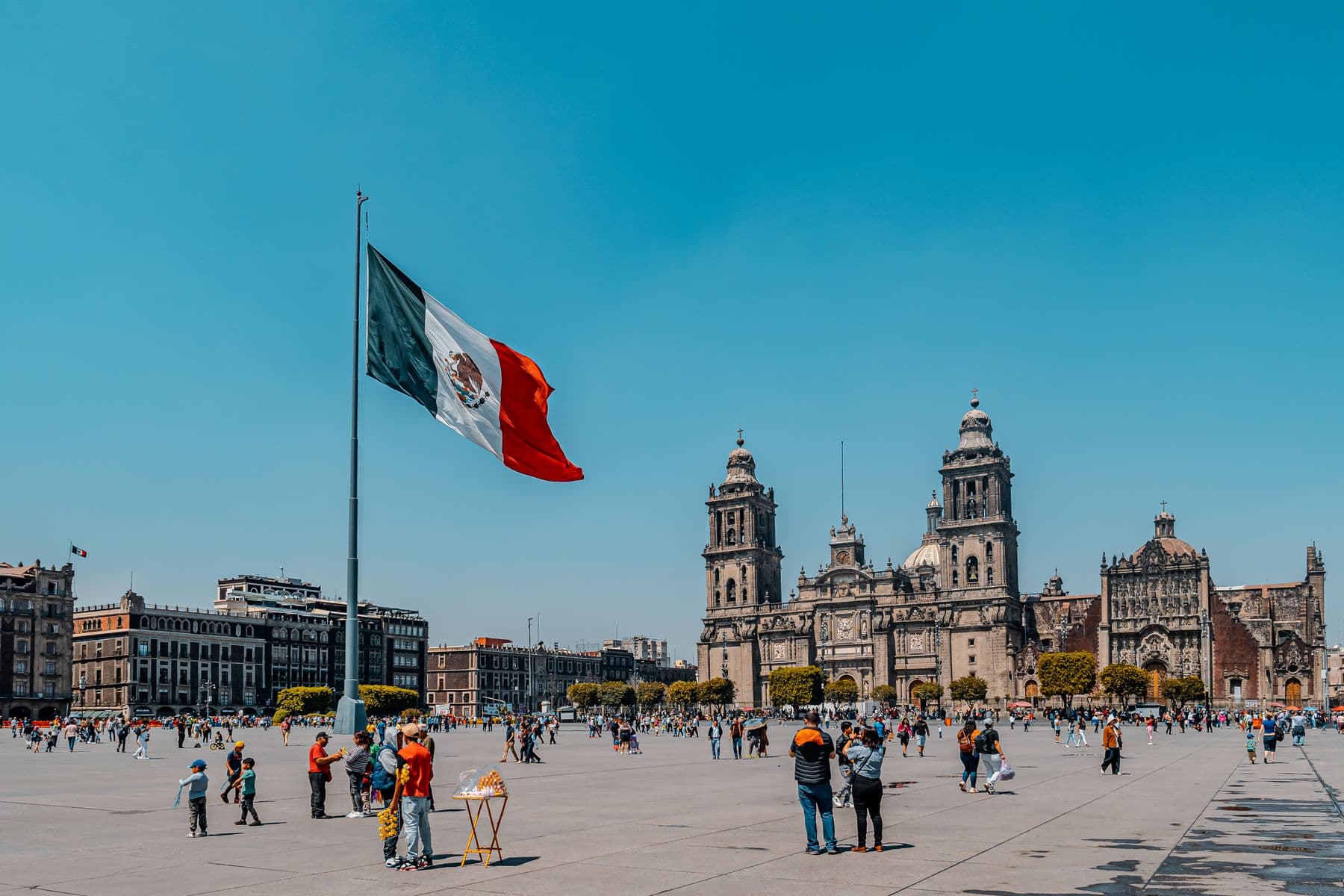
There is a place in Mexico City where you can stand on the 21st century and look down into the 14th. The Zocalo, officially the Plaza de la Constitucion, is the political, ceremonial, and emotional center of Mexico. It has been, without interruption, the center of power for every civilization that has controlled this valley for the last 700 years. No other urban space on earth can make that claim.
The Aztec Foundation (1325-1521)
When the Mexica people arrived in the Valley of Mexico, they were newcomers, a semi-nomadic group looking for a place to settle among established city-states. According to their founding myth, they would build their capital where they saw an eagle perched on a cactus, devouring a serpent. They found that sign on an island in Lake Texcoco, and there they founded Tenochtitlan.
By the early 1500s, Tenochtitlan was one of the largest cities in the world, with an estimated population of 200,000 to 300,000. At its center stood the Templo Mayor, a massive double pyramid dedicated to Tlaloc (rain) and Huitzilopochtli (war and sun). The ceremonial precinct covered roughly the same area as today's Zocalo and surrounding blocks. Causeways connected the island city to the mainland. Aqueducts brought fresh water. Chinampas (floating gardens) fed the population.
When Hernan Cortes and his soldiers first saw the city from the mountains above the valley, Bernal Diaz del Castillo wrote that they wondered if it was a dream. Nothing in Europe compared.
The Colonial Overwrite (1521-1821)
Hear a stop from this walk
Palacio Nacional: Three Layers of Power
After the fall of Tenochtitlan in 1521, Cortes ordered the city demolished and rebuilt as the capital of New Spain. The Templo Mayor was torn down. Its stones were used to build the Metropolitan Cathedral, which sits directly on top of the temple's foundations. The new city followed a Spanish grid pattern, but it mapped onto the existing Aztec layout more than the colonizers liked to admit. Many colonial streets follow the paths of pre-Hispanic causeways.
The Cathedral took over 200 years to complete (1573-1813), which is why it contains virtually every architectural style from Renaissance to Neoclassical. It also sinks unevenly into the soft lakebed, a constant, physical reminder that this ground was once water.
Across the square, the National Palace was built on the site of Moctezuma II's palace. The symbolism was deliberate: Spanish power would literally occupy the same space as Aztec power. For three centuries, viceroys governed half the Western Hemisphere from this building.
Independence and Revolution (1821-1920)
After Mexican independence in 1821, the Zocalo became the stage for a new nation's identity struggles. It witnessed the Mexican-American War, the French intervention that briefly installed Emperor Maximilian, the long dictatorship of Porfirio Diaz, and finally the Mexican Revolution.
The square's name tells its own story. "Zocalo" means "plinth" or "base." In the 1840s, President Santa Anna planned to erect a massive monument to independence in the center of the square. Only the base was ever built. The monument never came, but the name stuck. Mexicans have been calling the unfinished square by its unfinished monument ever since, a perfectly Mexican irony.
The Modern Layers (1920-Present)
In 1978, electrical workers digging near the Cathedral uncovered a massive stone disc depicting the dismembered moon goddess Coyolxauhqui. The discovery launched the Templo Mayor archaeological project, which has been excavating the Aztec ceremonial center ever since. Today, the ruins sit in an open-air site directly adjacent to the Cathedral, creating the city's most powerful visual juxtaposition: two civilizations' sacred architecture separated by a few meters and 500 years.
The National Palace now houses Diego Rivera's monumental murals depicting Mexican history from pre-Hispanic times to his imagined future. The murals are themselves a layer of meaning, a 20th-century artist's interpretation of the centuries that played out in the very building where his paintings hang.
Reading the Square
Stand in the center of the Zocalo today and turn slowly. To the north, the Cathedral and Templo Mayor ruins present the colonial-over-indigenous layering that defines the city. To the east, the National Palace represents continuous political power. To the south and west, commercial buildings from the 19th and 20th centuries fill out the square. Below your feet, archaeologists continue to find offerings, sculptures, and structures from the Aztec period.
The Zocalo is not a museum. It is a living political space where protests, celebrations, concerts, and ceremonies happen constantly. The massive Mexican flag at its center is raised and lowered daily by soldiers in a ritual that draws crowds. During Day of the Dead, the square fills with enormous altars. During the independence celebrations on September 15, the president reenacts the Grito de Dolores from the National Palace balcony.
Seven centuries, one square, still in use. Roamer's Heart of Empires tour walks you through this compressed history with GPS-triggered audio at each key point around and near the Zocalo, letting you absorb the layers at your own pace and in your own time.
Mexico eSIM· 10% off with ROAMER10
Ready to experience it?
Centro Histórico: Three Civilizations Deep
90 min · 2 km · easy
More from Mexico City
Explore more at your own pace.
Chapultepec Park Guide: Hill, Lakes and Museum Row
Coatlicue: The Statue That Was Buried Twice
El Sargento: The Dead Ahuehuete Tree of Chapultepec
The Baños de Moctezuma: The Bath That Was Never Moctezuma's
The Tlaloc Monolith: The Stone That Crossed Mexico City in 1964