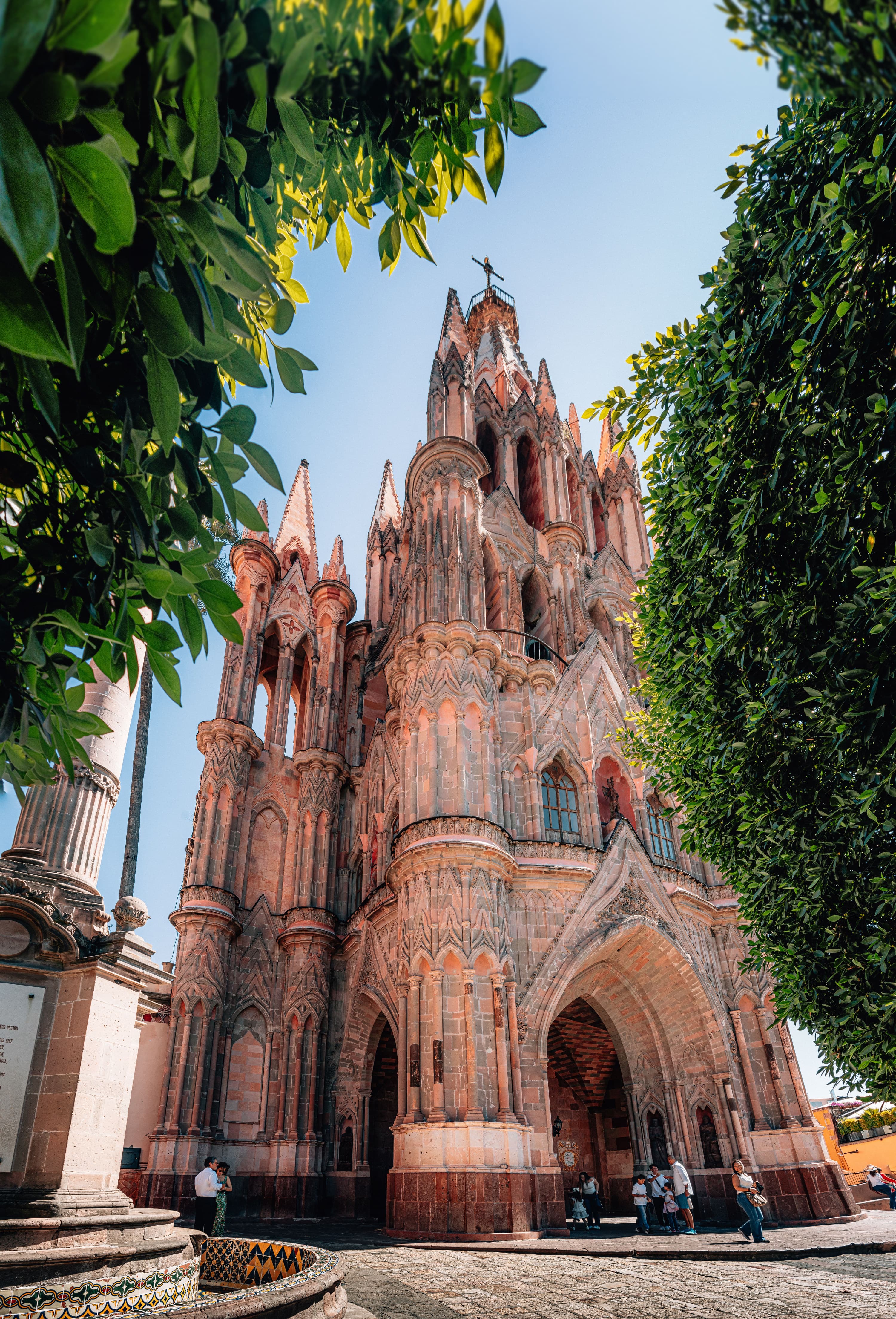
The Parroquia de San Miguel Arcangel is not what it appears to be. Its soaring pink spires, pointed arches, and Gothic tracery suggest a European cathedral transplanted to the Mexican highlands. But look closer and the details start to shift. The proportions are slightly off. The ornamentation is more exuberant than any French Gothic original. The pink cantera stone glows in a way that no building in Paris or Cologne ever could. This is not European architecture copied. It is European architecture reimagined by a local mason working from pictures, and the result is more interesting than any faithful reproduction could be.
The Original Church
The church behind the famous front was begun in 1683 and built through the late 1600s and early 1700s, a modest structure typical of colonial Mexican parish churches. It served the town for well over a century, its plain front blending with the surrounding colonial architecture. In 1880 the parish began something grander.
Zeferino Gutierrez and the Engravings
Hear a stop from this walk
Bellas Artes: A Convent, a Dome and an Unfinished Mural
In 1880, a self-taught Indigenous stonemason named Zeferino Gutierrez began a new front for the church. An American writer who met him, Sylvester Baxter, wrote in 1901 that he learned his Gothic from stray drawings and engravings, and that with no training as a draughtsman he marked out his plans for his workmen with a sharp stick in the sand. Later tellings turned those pictures into postcards of Cologne Cathedral; that part is legend, though Cologne Cathedral really was completed in 1880, the same year San Miguel laid its first stone. What he had was extraordinary skill with cantera stone, an artist's eye for form, and the creative freedom that comes from interpreting something you have only seen in two dimensions.
The result was a neo-Gothic facade unlike anything in Europe or Mexico. Gutierrez translated the vertical thrust of Gothic architecture into the warm, malleable cantera stone of the Bajio region. He added flourishes that no European Gothic architect would have used: curves where there should be angles, organic forms mixed with geometric ones, a sense of playfulness that the solemn cathedrals of Europe never permitted. The new front and spires, begun in 1880 and finished before 1901, transformed the San Miguel skyline and gave the town its defining landmark.
Why It Works
Architectural purists have occasionally dismissed the Parroquia as naive or inaccurate, a folk artist's misunderstanding of Gothic principles. This reading misses the point entirely. Gutierrez was not trying to build a European cathedral. He was creating something new, a translation, not a copy. The building's power comes precisely from the distance between the Gothic source material and the Mexican interpretation.
The pink cantera stone is central to this effect. Quarried locally, it changes color throughout the day: pale rose in the morning, warm coral at midday, deep salmon at sunset, and a ghostly luminescence under night lighting. No photograph fully captures these shifts, which is why visitors who have seen hundreds of images of the Parroquia are still startled by the real thing.
The setting amplifies the architecture. The Parroquia faces the Jardin Principal, San Miguel's central plaza, where shoe-shiners, balloon vendors, mariachi musicians, and tourists share benches under trimmed laurel trees. The church rises above this intimate, human-scaled scene with an almost theatrical drama. It is both the backdrop and the focal point of daily life in the town.
Inside the Parroquia
The interior is less famous than the exterior but worth attention. The nave is simpler than the facade suggests, with neoclassical altarpieces and a devotional atmosphere that reminds you this is still an active parish church, not a museum. Services are held daily, and during festivals, especially the feast of San Miguel Arcangel in late September, the church fills with processions, flowers, and music.
The side chapel dedicated to the Santo Cristo de la Conquista contains a figure believed to date from the early colonial period. Local devotion to this image is intense, and the chapel is often thick with candles and offerings.
A Living Symbol
The Parroquia is inseparable from San Miguel's identity. It appears on the town's official seal, on restaurant menus, on refrigerator magnets, and in the dreams of every visitor who has watched sunset turn its spires to fire. But it is more than a pretty building. It is a testament to creative independence, proof that a self-taught artist working from secondhand images and local materials can produce something that transcends its sources.
Zeferino Gutierrez died in 1916, during the years of the Mexican Revolution. He left no written account of his design process. His masterpiece speaks for itself, every day, in a language that requires no translation.
Roamer's self-guided Historic Center tour, eleven stops in a loop of about 2.7 km from the Jardín, makes the Parroquia its second stop, with audio narration covering the building's history, Gutierrez's remarkable story, and architectural details to look for both inside and out. Stand in the Jardin, put in your earphones, and let the story of the pink spires unfold at your own pace.
Mexico eSIM· 10% off with ROAMER10
Ready to experience it?
Historic Center: San Miguel in Pink Stone
90 min · 2.7 km · easy
More from San Miguel
Explore more at your own pace.
How San Miguel Became an American Town in Mexico
One Day in San Miguel de Allende: A Walkable Itinerary (2026)
San Miguel de Allende Travel Guide: How Many Days, Getting Around, When to Go (2026)

What to Eat in San Miguel de Allende: A Food Guide (2026)
How San Miguel Stayed an Art Colony When Every Other Mexican Town Became a Souvenir